By Eli Friedrich Getreu (1920–2005)
Translated from German, edited and annotated by Öyvind Vågen.
On a Danish farm in January 1939, Eli Getreu learns to milk cows and drive a sled while struggling with loneliness and the absence of his friends. Moments of warmth with the farmer’s family sit beside the testimony of fellow refugees and the news of persecution elsewhere.
Eli Getreu grew up in a Jewish family in Vienna and belonged to a Zionist youth movement preparing young people for agricultural life in Palestine. These excerpts form part of the diary project being developed by his grandson, the writer and literary translator Öyvind Vågen.
This is the English counterpart of Part IV of the Swedish series, first published on Critical Point on 2025-09-23. The diary text and annotations follow the current English edition.
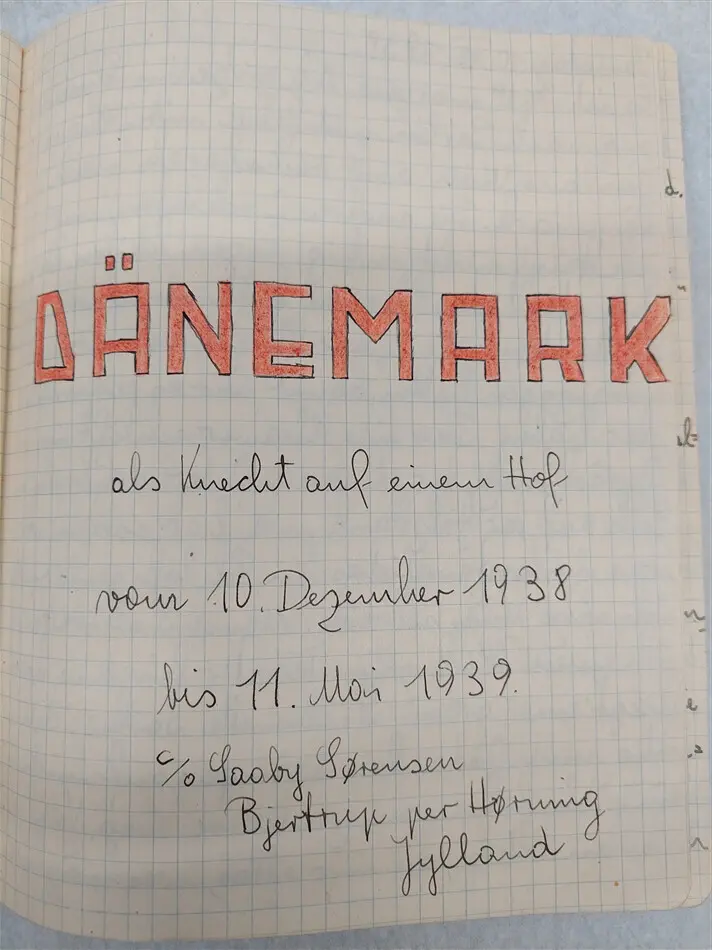
Sunday 8 January 1939
Letter to Vera…. My dearest Veramädi! I’m feeling down again today. Very down, in fact. You know, when you’re all on your own here like I am, and you’re longing so much for the Chawerim, you sometimes have some truly dreadful moments. I’m having one of those right now, this evening. Do you know why? No. Well, let me tell you why. On Sundays, as I’ve written to you, I only have to work in the mornings, from 6 a.m. to 10 a.m. in the cowshed. Then I’m free. Today, after having a wash and getting changed, I sat down in the heated parlor and played the mandolin. Then I read a Choser of the Hechaluz, which we receive every fortnight. I couldn’t write straight after work. I wanted to rest a little. Saaby wasn’t at home. Suddenly, Agnes came over to me at my desk and asked if I wouldn’t mind helping her sweep up the snow that had seeped through the roof onto the floor.
Of course, I couldn’t say no, so I went with her. I would have loved to slap her right across the face, standing there as she was, smiling sweetly at me with her false teeth. The whole job took 15 minutes, so not long, and besides, sweeping isn’t difficult work, but I was so furious; everything was boiling inside me; I’d just been reading the Woodhead report and wasn’t thinking about this place in the slightest, but my thoughts were back in Erez when I was rudely interrupted like that. You don’t have time here to reflect on yourself. You don’t have time to be a Jew. Except for that one day a week, when I want nothing else, I just want to be a Jew. I have so little time, after all. When I write in the evenings, I can’t relax; I’m always thinking, ’It’s late, I have to get up at 6 o’clock tomorrow.’ Always rushing; you can only think while working, and even then only when the work is light.
But that’s lovely when it happens. Not long ago, when I was preparing grain for threshing – you have to shove the sheaves from the barn to the threshing machine with a pitchfork – I found myself thinking of you all; yet I’m doing very well here. I know full well that I’ll never again in my life be as well off materially as I am in Denmark. But even so, it’s terribly hard. – Just now, as if to prove the opposite, there was a wonderful scene here. I was alone in the room with little Regner. We’ve had electric light here since yesterday. He’s absolutely delighted and keeps playing with the switch, turning it on and off, so that I cannot write. I tell him off, and he’s so sweet. That little blond-haired boy, standing by the switch and looking at me so innocently with his blue eyes.
I reach out my arms to him and call, ’Regner, come here’; he really does come; I lift him onto my lap. He hugs me; it’s completely quiet in the room; suddenly he starts to speak: ’Before, the first few days, you never stayed up late, you always went straight to bed.’ ’Yes.’ I say: ’Regner, now we’re two good mates.’ ’Yes.’ ’Regner, when I leave here, you’ll have learned to write at school by then, and we’ll write to each other. I’ll send you a photograph of myself, of my sister, and of Ruth (that’s what I call you here).’ He replies: ’Yes, I’ll send you a picture of myself too; I’ve got a really big one, and I’ll send it to you.’ That was lovely. I also said: ’Regner, do you want me to be your father?’ It was a marvelous experience. All in all, the Hachscharah here has its pros and cons.
On the one hand, it’s a drawback that I’m so alone here; on the other hand, it’s good. It’s rather like the experience of great men such as Jeschu and Moscheh – the time in the desert, the period of asceticism. I’m here all on my own. It’s not good for my emotions. I long for the Chawerim and so on. But on the other hand, I’m being toughened up; my will is being steeled. Getting through such difficult moments is no small matter, Vera; you know that, after all – it was the same for you, but you found someone there with whom you get on well. I won’t find anyone here, and perhaps that’s just as well. It remains to be seen whether I’ll stand firm or fall by the wayside. I’m trying not to give in. The people here, the other Chawerim, are all set in their ways.
When I turned up to see them on the first Friday wearing a white shirt, they laughed and said: ’Just you wait, you’ll soon get over that; it’s far too much bother.’ So far I’ve stuck with it and hope to keep going. For example, in Vienna it went without saying that I felt something on Friday evenings. Here it’s difficult. It’s hard to switch gears for just two hours. But there’s one thing I do. Every Friday at the start of Shabbat, I light two little candles and say the Brachia1 (blessing). It’s not just an empty ritual. There’s something behind it; every time I look at the two flames, I know that today is Shabbat. That means an awful lot to me. I’m a Jew again. – Vera, that’s enough now; I feel much lighter having written these things to you. Enough of the feelings. Now for something else.
Experiences at work. During the day. It’s quite strange, Vera: work that doesn’t fall within the realm of farming – such as, for example, the other day when I had to help Agnes mangle the laundry – interests me far less than stable work, threshing and so on. Saaby won’t let me carry the heavy sacks of grain that are taken to the mill. The other day, when he’d just stepped away for a moment, I tried it on my own. I carried two sacks on my back. Don’t ask how – I was just staggering about – but I carried them. I was proud – oh, was I proud! Well, Saaby saw this, and now he lets me do it too. – Another experience. Today I milked; I’d tried it recently. It goes quite well with my right hand, but with my left it’s a disaster. The day before yesterday, Saaby and I were alone in the cowshed; he was milking, and I was milking my cow, with both hands.
Suddenly – as with everything, there’s a little trick to it – I’d got the hang of it. With both hands. The thin stream of warm milk flowed steadily into the bucket. No one could have been happier than me. I’d managed it again. I couldn’t contain myself any longer. I shouted: ’Saaby, look, I can milk – with both hands.’ I couldn’t see him; he was hidden behind another cow, but he stopped milking; it was completely quiet in the barn, with only the sound of the milk splashing into the bucket. Oh, that was something. – Or, just the other day, Saaby and Agnes were away all day in Aarhus – that’s the nearest city to here – and I had to work on my own all day. It’s a completely different feeling, Vera; among other things, I even went into town all by myself to collect a parcel my parents had sent me from the post office.
That’s lovely too. Doing everything all by myself – putting on the harness, harnessing the horse, and then off we go in the sled. The feeling is indescribable. You feel in control of everything. I can lead the horse anywhere I want. The reins, the snow – absolutely fabulous. The fact that I overturned on the way back because of a car (Vogh) isn’t really important and doesn’t take away from the joy of the ride.
Saturday, 28 January 1939
I’m in the cowshed, grooming the cows. It’s light work, and it reminds me so much of the times when, on Sunday afternoons, I’d walk along Lerchenfelderstraße in my new suit and follow the Zweierlinie to the Heim. The sun was shining, everyone was dressed in their Sunday best, the town hall looked so golden-yellow from behind, and I always thought that if this weren’t Vienna, I’d look at that building with completely different eyes. And whenever I walked past it, I longed for Vera. Now, here in the cowshed, I wonder whether I wasn’t just as alone back then; I can’t even imagine it any other way. It’s so strange: on the one hand, I’m glad of this peace and quiet here in the countryside; everything goes on calmly, nothing is rushed, even the landscape is serene; on the other hand, being so alone, sometimes I feel as though I’m dissolving with longing, so despondent am I, and at other times I’d like to embrace the whole landscape with my arms all at once.
Sunday, 29 January 1939
Letter to Vera…. Vera, all I can think of is longing, and how best I can escape this hell of loneliness. In the evening, Chanan came from the Maskiruth2 and told us about the political situation in the world and among the Jews. Before that, there were practical matters. There were two new Chawerim here. One had spent two and a half months in Dachau, and the other, already 29 years old, had served two and a half years in a Zuchthaus (a hard-labor prison). Chanan asked how everyone was getting on with their work, and when it was the turn of this 29-year-old Chawer, he began in a grave voice, softly and slowly, fear still evident in his eyes: ’Chawerim, I can’t take it any more, I’ve only been here for two weeks, but the work is too hard for me. I can’t keep this up. I’ve been so worn down by the two-and-a-half years in prison, by the watery soup, by the Gestapo’s cross-examinations that I had to endure every day – I didn’t sleep; it was terrible.
My farmer isn’t happy with me, I know that; but I just can’t do it. I fall over even when pushing an empty wheelbarrow. Help me!’ When he had finished speaking, it was completely silent; we’d been joking around just before, but then it was quiet – eerily quiet, in fact. Here was a victim of those Nazi dogs. Just one among many thousands. I felt sick; I wanted to scream, and I thought about just how lucky I’d actually been. It seemed like a crime to me to laugh, not just during those few minutes when the impression was still fresh and clear. I thought it was wrong – I’m laughing while other Jews, members of my own people, are suffering. But then I told myself, there’s no point in it anyway. – Then Chanan spoke about the situation. Jews, persecuted here, persecuted there tomorrow – a sad, wretched picture, a disgrace to the world.
But then he began: ’In Erez, the government has banned the establishment of new settlements; last week, two settlements were established against the will of the British government. The government is issuing too few certificates; we’ll just carry on with our own certificates. In recent months, 1,800 Jews have entered the Land legally and 2,000 illegally from all over the world. The Chaluzim . . . . .’ When I came home, I found it hard to be a Jew. I wanted to be a Danish farmer, thinking of nothing but pigs and having no worries. When I thought of the Jews who are in the no-man’s-land between Czechoslovakia and Hungary and do not know which state they belong to, nobody wants them. But then I was proud to be a Jew. I do not want to belong to any other people. For we have the Chaluzim . . . . .
Notes
[1] Brachia / berakhah. The source form ‘Brachia’ very probably denotes Hebrew berakhah, ‘blessing’. Eli writes that every Friday at the beginning of Shabbat he lights two small candles and says ‘the Brachia’. Since he does not give its wording, no particular prayer formula is reconstructed here.
[2] Maskiruth. Maskiruth, Hebrew mazkirut, here denotes the jointly elected leadership of Kibbutz-Aliyah-Danmark. Established in 1933 and also called the ‘Hechalutz office’, it was based at Nørregade 20 in Copenhagen and coordinated correspondence, travel, seminars, placements, and travelling madrichim, among other tasks.
Read the corresponding Swedish excerpt and the diary series on Critical Point.