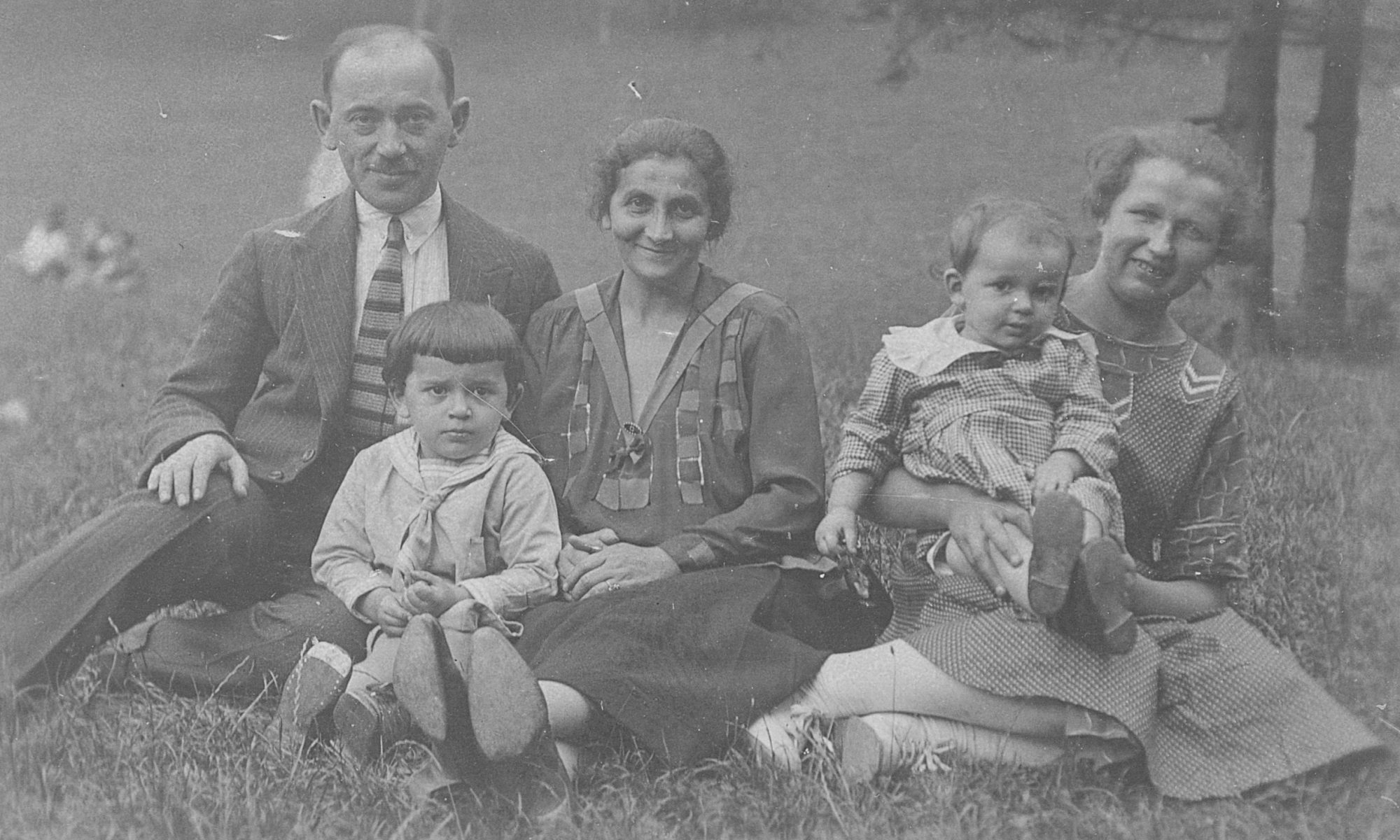
By Eli Friedrich Getreu (1920–2005)
Translated from German, edited and annotated by Öyvind Vågen.
On 10 November 1938, eighteen-year-old Eli Getreu recorded the November pogrom in Vienna as events unfolded around him. His diary moves between the streets, his family’s flat and the precarious safety of friends and neighbours.
Eli Getreu grew up in a Jewish family in Vienna and belonged to a Zionist youth movement preparing young people for agricultural life in Palestine. These excerpts form part of the diary project being developed by his grandson, the writer and literary translator Öyvind Vågen.
This is the English counterpart of Part I of the Swedish series, first published on Critical Point on 2024-12-31. The diary text and annotations follow the current English edition.

Thursday, 10 November 1938
Impressions of a day in Vienna, Germany. Early this morning, on my way to the Town Hall, I read in the newspaper that First-Class Legation Councillor Ernst vom Rath1, who had been seriously injured by the seventeen-year-old Jew Grünspan, had succumbed to his injuries in Paris. I went to the Town Hall to deal with my clearance certificate [Unbedenklichkeit] and listened to what people were saying and recounting; for example, one gentleman said: ’Today at 7 o’clock in the morning, officers and soldiers came to my flat and explained that they had been ordered to search for weapons. They were very kind and polite.’ A few other gentlemen said that something similar had happened to them as well, and so on. Then I went, or rather intended to go, to the Palestine Office. I was already on Marc-Aurel-Strasse, ten paces from the entrance; I was surprised that nobody was standing there, as there are usually a great many Jews standing outside the front door, but I didn’t think much of it and walked toward the front door.
Suddenly I saw an old woman go into the building, but she immediately ran back out again. Immediately afterward, an SS man wearing a steel helmet2 and a military overcoat came running out of the entrance after her, said something to her, whereupon they both disappeared back inside. When I saw that, I stopped in my tracks. Then a Chawer from the J.P.Ö.3, who looked like an Aryan and was also wearing work clothes, came up to me and told me to go home, that the Palestine Office and the K.G.4 had been occupied, and that at the synagogue in Seitenstettengasse the Torah scrolls had been dragged out onto the street, and so on. But I didn’t go home; instead, I went to the Maskiruth5 to warn them to lock up, but it was already closed. Then I went home. I met Herbert Schmelz, who told me that his brother’s home had also been searched for weapons.
I carried on home. Near the Bellaria6, two cars suddenly whizzed past me. The first was an open-top Steyr 1007, in which a few party members sat and stood. The second car was a small enclosed car; the driver was sitting at the front, and next to him was a party member. Two or three Jews were sitting in the back. I saw only one face, but I shall never forget it. The boy, who looked about sixteen, wore a brown suit and glasses, had black hair, and stared out the window with a look of despair. The two cars kept honking their horns the whole time and were driving at breakneck speed. I watched them drive off; when I looked ahead again, I saw David R., who was on his way to the Maskiruth. I told him what I’d seen, whereupon he turned around and we went to my place.
On the way, he told me he’d seen a ’grüner Heinrich8’ (police prison van) driving past, with a Jew sitting next to the driver instead of a guard, as was usually the case. It must have been that crowded. As no one was at home and I didn’t have any keys, we went for a walk along Lerchenfelderstraße9 to watch the road being repaired. There, outside the Zeisel textile shop, we saw an Aryan man wearing a party badge, a brown shirt, and flat slip-on shoes; another man ran across the road, though we couldn’t see where he was going. Then Mr Zeisel came out of the shop and wanted to stop in the street, but the Party official said something to him and shoved him back into the shop. We carried on walking. Suddenly, Robin came out of a shop with his face all red. I noticed this straight away and asked: ”Did they beat you?” ”A little.” ”Where?” ”At the K.G.10” ”How?
Slaps?” ”Slaps would have been all right. The whole building is occupied, and they said, ’Right, stand quietly against the wall now,’ and then they punched me in the face, and so on.” Then we turned around and walked past Zeisel’s again. There we saw three or five people in boots carrying bales of fabric out of the shop across the street and loading them onto a van. A man was standing there, writing everything down. A passer-by stopped, whereupon the man went over to him and said: ”What are you looking at? Keep moving!” We went back to my place, but no one was home, so we went to the market hall11 to look for my mother. Of course, we didn’t find her. Then we went to David’s flat, as Robin had told us that you absolutely must carry your documents with you, otherwise they will pick you up.
He hadn’t had his documents with him at the K.G., and it was only when a friend had fetched them for him that he was released. So we went to see him, and in the meantime I looked through the letters that Dally F. had written to him from Plescherken12. There was a great deal about me in them. Then I looked through his photo album. Suddenly we heard an explosion and couldn’t make sense of it. Later, David’s father came round and told us that a few relatives in the 5th district had been taken away when the authorities had searched their homes for weapons. He also told us that there were so many people gathered outside Katany’s, a Jewish clothes shop, and that everything was being requisitioned; that the Thurnertempel13 had been set alight, and so on. We then went to my place. As we came out of David’s house, we came across a grocer—David knew him—who said, ”Get yourselves home, you Jewish swine.” We carried on; on the corner of Schottenfeld and Neustiftgasse we saw a Jewish radio shop locked up and sealed by the N.S.K.K.14 When we reached the corner of Neubaugasse and Neustiftgasse, the Jewish timber shop was locked up.
We arrived at my place; as I opened the door, Mama came running out to meet me, crying with joy, kissing me all over and delighted that I was there. Papa had locked up the shop and was at home too. Mama asked if we’d heard the explosion; apparently, the Neudeggertempel15 had been set alight and blown up (though I don’t know if that’s true). David left soon after that, and our neighbor came home. She lives next door to us along the corridor. (I was just about to write, ’Vera, you already know her, the little one’—it was her sister.) I’ve just realized that I’m writing this diary not only for myself but also for Vera, and that’s fine. She told me that she worked at a photographic studio; suddenly nine men had come in, taken everything away, and ransacked the place. As an Aryan, she was now going to report the incident to the police16.
Then a woman from our building, who lives across the courtyard off the third staircase, came over and asked me to help her carry the little table she’d bought from us back home. As I was leaving, Mama said: ’Take it there quickly and come straight back.’ As I walked back from there, across the whole courtyard, I wanted to go out onto the street and see what was happening there, just for a moment. I thought long and hard about whether I should dare. Then I looked out after all. On the street, everything looked calm and unchanged. Suddenly I heard a horn blare, just as I had earlier near the Bellaria, then a car whizzed past, and I was immediately reminded of the tragedies I’d witnessed and which are still unfolding. Life today is like living in the darkest Middle Ages; you don’t even dare to go out onto the street.
You think twice—a hundred times over. A letter from Vera also arrived today, which made me very happy. After lunch, I lay down on the divan and read The Story of Mankind by Hendrik von Loon. I read a chapter, then slept until half past four, got up, paced about the room—to be honest, I don’t know what was happening to me. Mama was sitting alone in the kitchen because it was too hot for her in the heated room. Papa was reading the newspaper. Suddenly—I was lying on the divan again—I heard Mrs Kastl shouting out in the corridor, making sure we could hear her: ’Jewish flats are being looted in Neubaugasse.’ Then I felt so wretched; I didn’t know what to do. I had the crazy idea of playing the mandolin to take my mind off things. I didn’t want it to be so deathly quiet in the flat.
Then Mama bought the newspaper; when she came back, the three of us pounced on it and searched for what it said about the atrocities taking place against the Jews in Vienna today. A short note: ’Anti-Jewish demonstrations throughout the Reich. Several synagogues burnt down. Neudeggergasse, Schopenhauerstraße, Müllnergasse, etc.’ Suddenly there was a knock at the door and Mrs Seinfeld came in. Ben arrived shortly afterward. There was something strange about it. I’d already been wanting to know what was happening to our people, and it was such a comforting feeling that there was another Chawer there—just a Chawer. He told us what he’d seen, and so on. That afternoon, he’d cycled past the monastery on Kenyongasse17. That’s where Jews from all the police stations are being herded together. They arrive in taxis and police emergency vans; there are two SS men with rifles at the ready at the entrance, and the Jews have to run from the vehicle to the gate.
Ben told me everything he saw. One Jew appeared to be injured, so two other Jews were carrying him. They had to run too. One Jew ran to the side, trying to escape. One of the SS men fired at him; the Jew fell to the ground and was carried inside. Then Mr Seinfeld and Mrs Vogelbaum arrived. Mama asked Ben to check whether our shop had been looted as well. As he was here on his bike, he went to do so. I agreed with him that if anything had happened at the shop, he should tell me first, and I would go out to meet him. I couldn’t wait for him to come back and went to the lavatory on the landing to watch for him there. Suddenly, I heard a noise in the hallway, as if from two pairs of boots. Two men stood there: one in boots, the other in ordinary clothes.
They looked at the nameplate on Kastl’s door, then knocked on ours. ”N.S.D.A.P.18,” they said. I thought—and was afraid—that they might have come to take me away, so I stayed in the toilet. I’ll never forget those few minutes. I kept my fingers crossed, searching my memory for prayers or anything at all while I listened. I heard words like: ”Where is the son… leave the flat immediately… half an hour… Myrthengasse19… etc.” No sooner had they left than Mrs Kastl came up the stairs, greeted them with ”Heil Hitler”, winked warmly at the two men and clenched her fist, as if to say, ’Go on—give them what they deserve20.’ My mother said that was impossible in such a short time, whereupon the second man—who was a very decent person—patted Mama on the shoulder and said: ’One and a half hours.’ No sooner had they gone out than Ben came back.
The shop was indeed untouched, and he went straight home to check if everything was all right there. I asked him to stay, but he said: ”I can’t, I have to go home.” Afterward, I was ashamed of myself for having asked him to do such a thing, given that he hadn’t been home since this morning. We immediately packed two suitcases; the two Party men had said we had to go to Myrthengasse to see Engineer Koller, but nobody knew the house number, so Mrs Vogelbaum went off to look for it. We packed whatever we could get our hands on into the suitcases: the silverware, the money, the fur coat, shaving kit, stockings, shirts, towels, and so on. Suddenly the two men came back and said we could stay; there were no rooms left. But that was just an excuse, because we’d heard Goebbels announce on the radio that all ’individual actions’ were to cease immediately; everything would be directed from above.
So, we were absolutely delighted. Then Mrs Vogelbaum came back and said that Engineer Koller lived at number 6. When she found out that we were allowed to stay here, she was happy too. But because of the commotion—she herself had been forced out early that afternoon—she needed some release; she burst into tears and wept it all out. I understood her completely. Today I’ve come to like her; she’s a very decent woman. When the two men returned to tell us that we were allowed to stay, one of them—the kind man—spoke very gently and said: ’Well, you’re allowed to stay here,’ and as Mama looked quite taken aback, he said: ’Surely you’d prefer that.’ He didn’t say it the way one normally speaks; the way he said it was quite strange. I gathered from this that he wanted to help us; he was sickened by his task and by the misery he must have witnessed that day; with those words, he almost seemed to want to caress and comfort us.
Then Ben came back to help us; thank God nothing had happened at his place; he stayed with us for a while, then left. I went to bed later. I wonder whether tonight will pass quietly. Ben said that all the Party formations have been called in today. Either they are to prevent looting during the night, or something even worse is on the way. I don’t think anything else will happen. I keep thinking how dearly I love my parents, and yet I have to leave them. What would have happened if I had already left, with those two dear old people alone in the flat? It’s unthinkable. Mama said to Papa, for example: ’You must never let a poor Jew go without giving him something.’ My writing is very jumbled, and I’ve forgotten a lot too, but events are coming thick and fast today. Then Papa asked me whether I believed in destiny, and so on.
But help really did come at the last moment. A person with little knowledge, a simple-minded person, must in any case believe that there is a higher power that intervenes in life. Later, I opened the window because I was too hot—mainly inside—and looked out. I heard boots again. Four soldiers were patrolling the streets. They stopped at number 54 because a removal van was there and furniture was being unloaded, but they soon moved on. It must have been connected with today’s events.
Notes
[1] Ernst vom Rath. Ernst vom Rath (1909–1938) was a diplomat at the German embassy in Paris. Seventeen-year-old Herschel Grynszpan shot him on 7 November 1938; vom Rath died on 9 November. The Nazi regime used his death as a pretext for the November pogroms of 9–10 November.
[2] Stahlhelm. Here Stahlhelm denotes the German military helmet introduced during the First World War.
[3] J.P.Ö. The reading J.P.Ö. has been checked again against the original scan. In context it denotes a Jewish movement organization; no reliably documented expansion has been found, so none is supplied.
[4] K.G. K.G. here very probably denotes the Israelitische Kultusgemeinde Wien, the Vienna Jewish Community. This is supported by the diary context and a near-contemporary document from the community’s archive that uses K.G. as an abbreviation for Kultusgemeinde; Eli himself does not expand it.
[5] Maskiruth. Hebrew mazkirut: secretariat or leadership. In the Austrian Hechalutz organ CHOSER, Maskiruth denotes the movement’s secretariat or leadership; the Vienna entry of 10 November 1938 therefore very probably refers to the Vienna Hechalutz leadership office. Its exact address and institutional boundaries remain open.
[6] Bellaria. Bellaria here denotes the area around Bellariastraße and the Ringstrasse in central Vienna.
[7] Steyr 100. The Steyr 100 was a passenger car made by Steyr-Daimler-Puch AG. The model was introduced in 1934 and produced until 1936; the further-developed Steyr 200 followed in 1936 and remained in production until 1940.
[8] grüner Heinrich. In Austria, ‘grüner Heinrich’ was a colloquial term for a prisoner-transport vehicle. Historically the expression is documented for the Vienna police’s enclosed, green-painted horse-drawn wagons; in the diary context it refers to a motorized police vehicle.
[9] Lerchenfelderstraße. Lerchenfelder Straße runs along the boundary between Vienna’s 7th and 8th districts and forms part of the route described in the diary near the family home at Neustiftgasse 50.
[11] Markthalle. The reference is very likely to Neubau’s retail market hall on the site Neustiftgasse 30–36/Kellermanngasse 1–8. It stood near the family home at Neustiftgasse 50 and on the route described. Since the diary says only ‘Markthalle’, the identification remains strongly probable rather than conclusive.
[12] Plescherken. Plescherken is a locality on the Wörthersee in Carinthia, now part of the municipality of Keutschach am See.
[13] Turnertempel. The Turnertempel was a synagogue at Turnergasse 22 in Vienna’s 15th district. It was set on fire and destroyed during the November pogrom.
[14] N.S.K.K. NSKK stands for Nationalsozialistisches Kraftfahrkorps, the Nazi Party’s mass organization for motor transport and motorization. It provided driving and technical training, carried out transport tasks, and was organized along paramilitary lines.
[15] Neudeggertempel. The reference is to the synagogue at Neudeggergasse 12 in the 8th district, destroyed during the November pogrom. Eli’s statement about an explosion is a contemporary report that he explicitly leaves unconfirmed.
[16] Kommissariat. Kommissariat here means a police commissariat or police station.
[17] Kloster in der Kenyongasse. The likely reference is to the convent and school complex of the Sisters of the Divine Redeemer on Kenyongasse. The concentration of arrested Jews there is attested here by Eli’s contemporary report; independent confirmation remains outstanding.
[18] N.S.D.A.P. NSDAP stands for Nationalsozialistische Deutsche Arbeiterpartei, the National Socialist German Workers’ Party, which ruled Germany as a dictatorship from 1933.
[19] Myrthengasse. According to the diary, Myrthengasse 6 was the address subsequently found for Engineer Koller, with whom the family was to take a room. The street and number are attested in the diary; the occupant and function have not yet been independently verified.
[20] gebt es ihnen nur recht. The source literally reads ‘gebt es ihnen nur recht’. The translations render the threatening gesture idiomatically; its precise nuance remains context-dependent.
Read the corresponding Swedish excerpt and the diary series on Critical Point.