
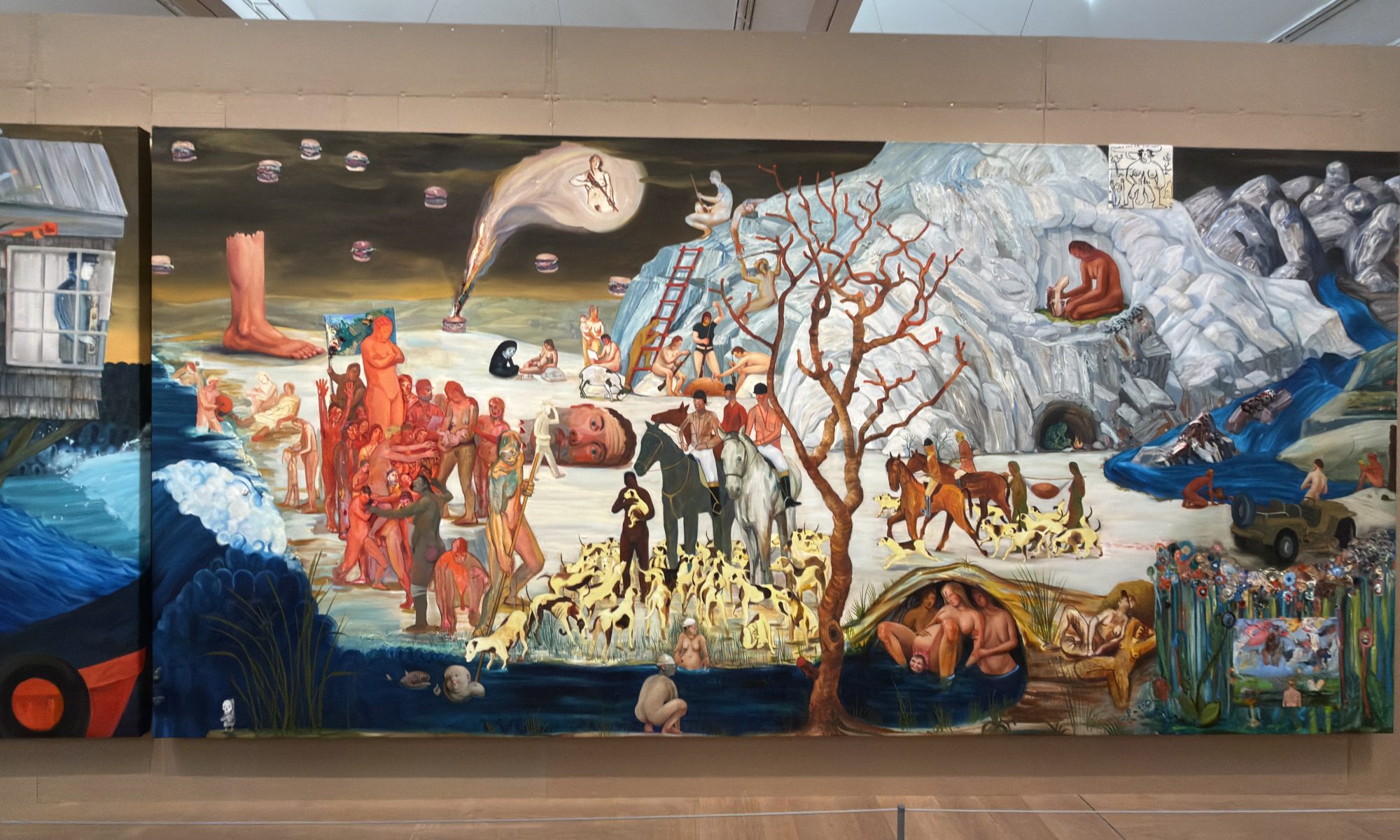
House of Nisaba: New Stories of Painting at Moderna Museet asks what figurative painting can still do in a fractured present. Our new art correspondent, Chiara Gelmini, follows the exhibition as a temporary house of images, where myth, memory, politics, bodies, and allegory become tools for thinking when linear narratives no longer suffice.
By Chiara Gelmini
How is painting doing today?
It is with this question that I enter House of Nisaba: New Stories of Painting. Curated by Hendrik Folkerts, currently Chief Curator of Programme at Kunsthaus Zürich, the exhibition is co-organised by Moderna Museet and Kunsthaus Zürich, where it will be presented in 2027. The project, therefore, takes the form of a passage: not only between two institutions, but also between different questions concerning painting, narrative and the capacity of images to produce knowledge in the present.
The question is not new. Throughout the twentieth century, painting was repeatedly challenged as a privileged form of representation. In a very different historical and political context, between the late 1970s and the early 1980s, Achille Bonito Oliva theorised the Transavanguardia as a postmodern response to the crisis of the avant-garde and to the presumed exhaustion of painting: a return to gesture, figuration, quotation and individual mythology.
House of Nisaba reopens that question from another perspective. It does not simply celebrate the return of figurative painting; it asks how images might still provide orientation in a present marked by overlapping crises. Here, the return to figuration does not appear as nostalgia, but as the possibility of constructing images capable of holding conflict, ambiguity and multiple layers of meaning.
House of Nisaba and the question of narrative
The title refers to Nisaba, the Mesopotamian goddess of writing and the transmission of knowledge. Originally associated with fertility, grain and accounting, Nisaba later became a goddess of writing: a transitional figure between matter, recording and thought. Her presence in the title is therefore more than evocative. It marks a passage between image and narrative, archive and invention, memory and new systems of knowledge.
“Painting, here, is not simply a surface to be observed. It becomes a way of giving form to what remains unstable, fragmentary and difficult to articulate.”
This reference is crucial. The exhibition does not merely ask what condition contemporary figurative painting is in; it asks how images today can still produce memory, narrative and knowledge. Painting, here, is not simply a surface to be observed. It becomes a way of giving form to what remains unstable, fragmentary and difficult to articulate.
Artists, the curator reminds us, have always used symbols that for many centuries could be understood by viewers even when they were unable to read. Today, according to Folkerts, we inhabit a very different landscape. Artists are compelled to develop individual languages in a world where information travels ever more rapidly, while the meaning of symbols is no longer collectively shared. Amid this loss of a common symbolic code, Nisaba becomes a transitional figure through whom we can reconsider the preservation of history, the transmission of culture and the possibility of knowledge in constant transformation.
The exhibition and its architecture
Even before entering the museum, visitors are met by the presence of Alexander Calder, Niki de Saint Phalle and Jean Tinguely outside Moderna Museet, on the small Stockholm island of Skeppsholmen. During these months, the museum’s rich programme brings together several temporary exhibitions and new presentations of the collection; Brassaï’s Secret Paris stands out among them. Yet the itinerary extends beyond the exhibition itself, towards the Pontus Hultén Study Gallery, designed in collaboration with Renzo Piano, and towards nearby ArkDes, with its architecture and design archive — material that would deserve an article of its own, not least because of the charismatic gallery attendant Pepe. For now, I choose to enter House of Nisaba: New Stories of Painting.
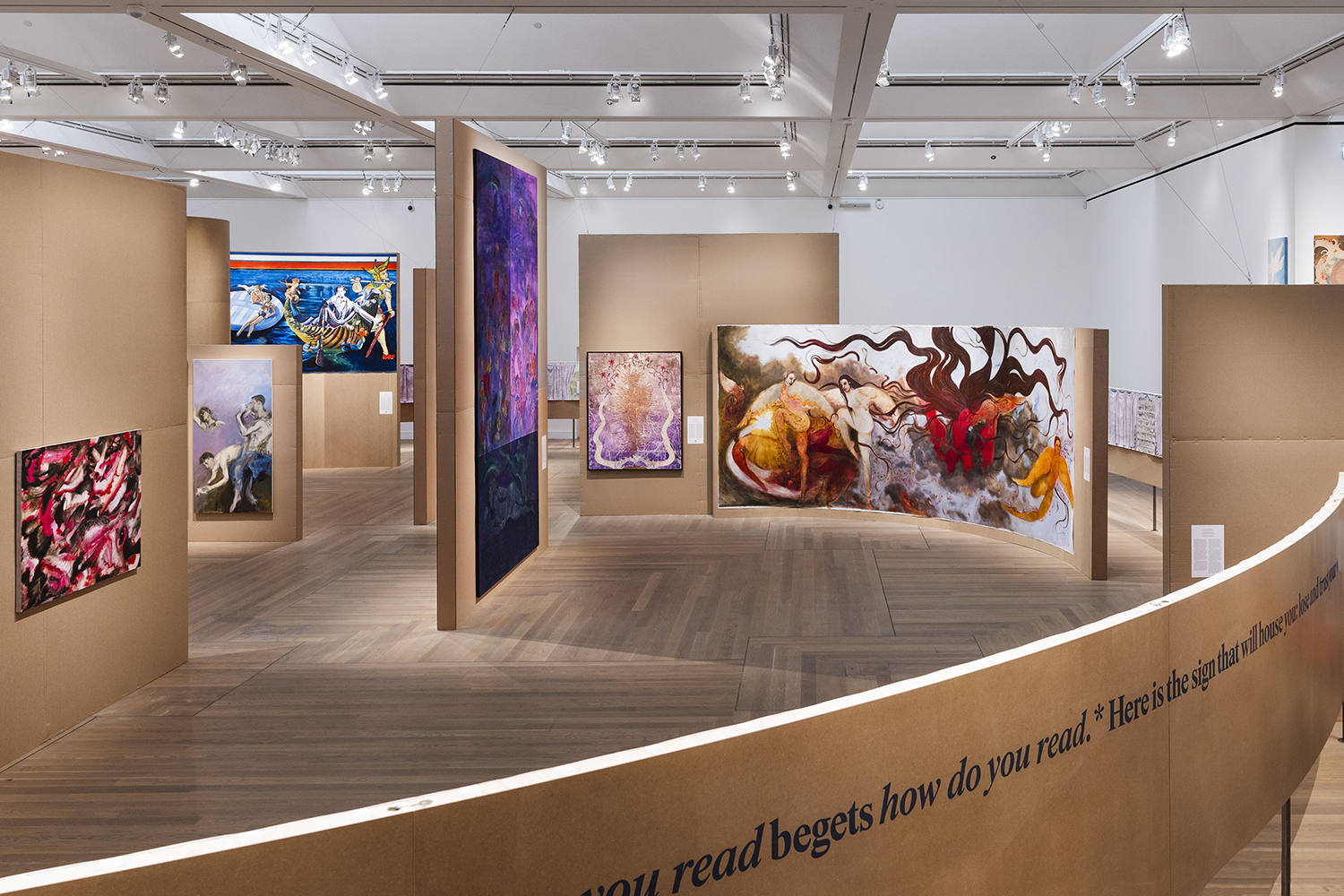
The exhibition design, created by the Milan-based studio Formafantasma, constructs a provisional environment within a single large hall. Cardboard, plywood panels, natural colours, curved structures and internal passages guide the viewer along a route without rigid hierarchies.
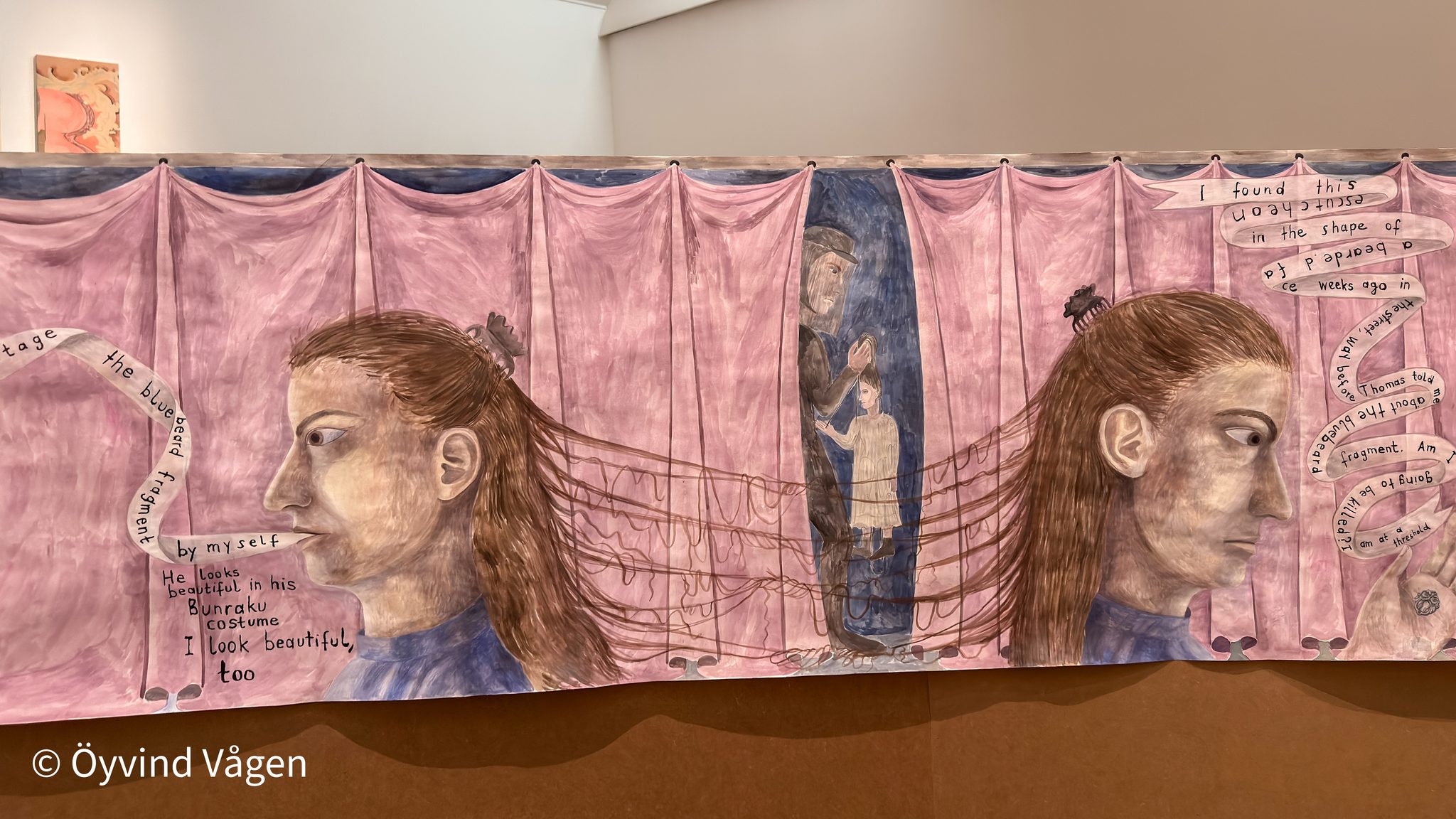
From the outside, the structure greets visitors with a ring, an ambulatory along which Agnes Scherer’s exceptionally long panel Études Marginales (2026) unfolds: almost a contemporary Biblia pauperum, in which the artist stages an alter ego acting across different moments and, as in a puppet theatre, appearing to pull the strings of what takes place within the images. Inside, the space is articulated through further concentric panels, almost like the layers of an onion, evoking at once a construction site, an archive and an ancient labyrinth. Unity within fragmentation and asymmetry thus becomes a key concept: not merely stated, but made visible through the dialogue between the architectural structure and the works.
“More than a temple of painting, this house appears as a nomadic construction.”
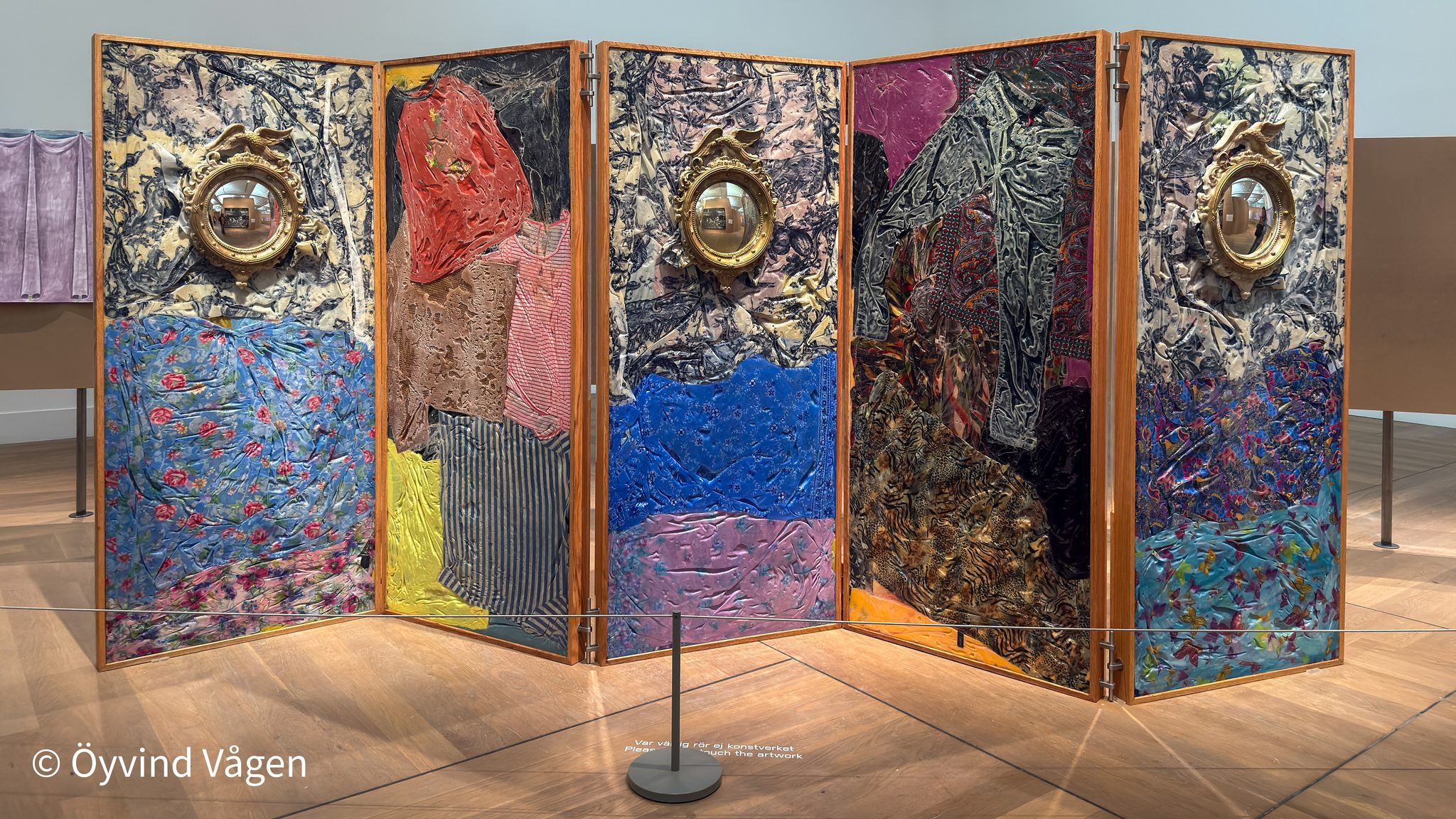
Matthew Lutz-Kinoy reinforces this idea of the exhibition as both house and construction with Domesticating Heaven: Gay Caryatid; Groups of Children in the Sky; Innocent Repetition; Putti Psychobiography (2026). His vertical panels, also inspired by Fragonard’s Rococo painting, function as columns, architectural elements, aesthetic objects and supporting structures. In Lutz-Kinoy’s work, the reference to Adolf Loos and Ornament and Crime is overturned: ornament is no longer a regressive residue, but a political, queer and anti-functionalist form.
More than a temple of painting, this house appears as a nomadic construction: a place in which the works are not arranged according to a linear genealogy, but gathered as a constellation of stories, bodies, myths and moving images; a place where the artists seem to be grouped not simply by theme, but by sensibility.
Allegory as a conceptual framework
The exhibition’s architecture prepares the ground for its central conceptual framework: allegory. In its original sense, allegory denotes a representation that says more than it literally depicts. In House of Nisaba, however, allegory does not function as a closed symbolic code in which every figure refers to a stable meaning. It becomes instead a complex, open structure of meaning. A single image can hold together several planes — biography, art history, politics, trauma, spirituality, digital culture, myth and desire — without resolving itself into a single interpretation. It is a language that opens possibilities precisely when established forms of language are no longer sufficient.
Among the opening themes identified by Folkerts is mythology, which helps us understand the exhibition not as a simple return to figuration, but as the construction of symbolic worlds. Myth is not presented here as an archaic or reassuring refuge. Instead, it functions as a form of mediation through which biography, history, desire, trauma and imagination can take shape without becoming fixed within a single identity.
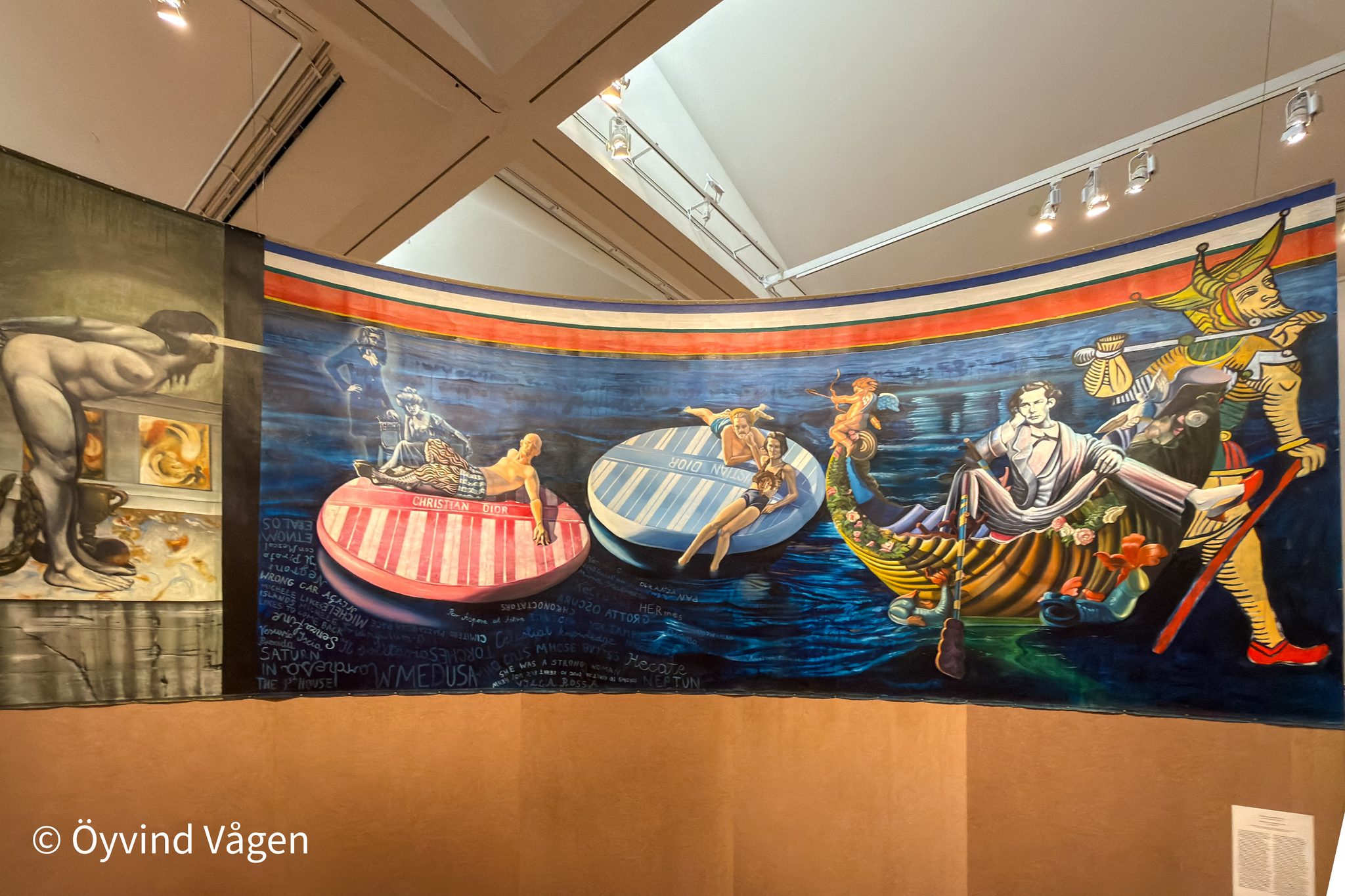
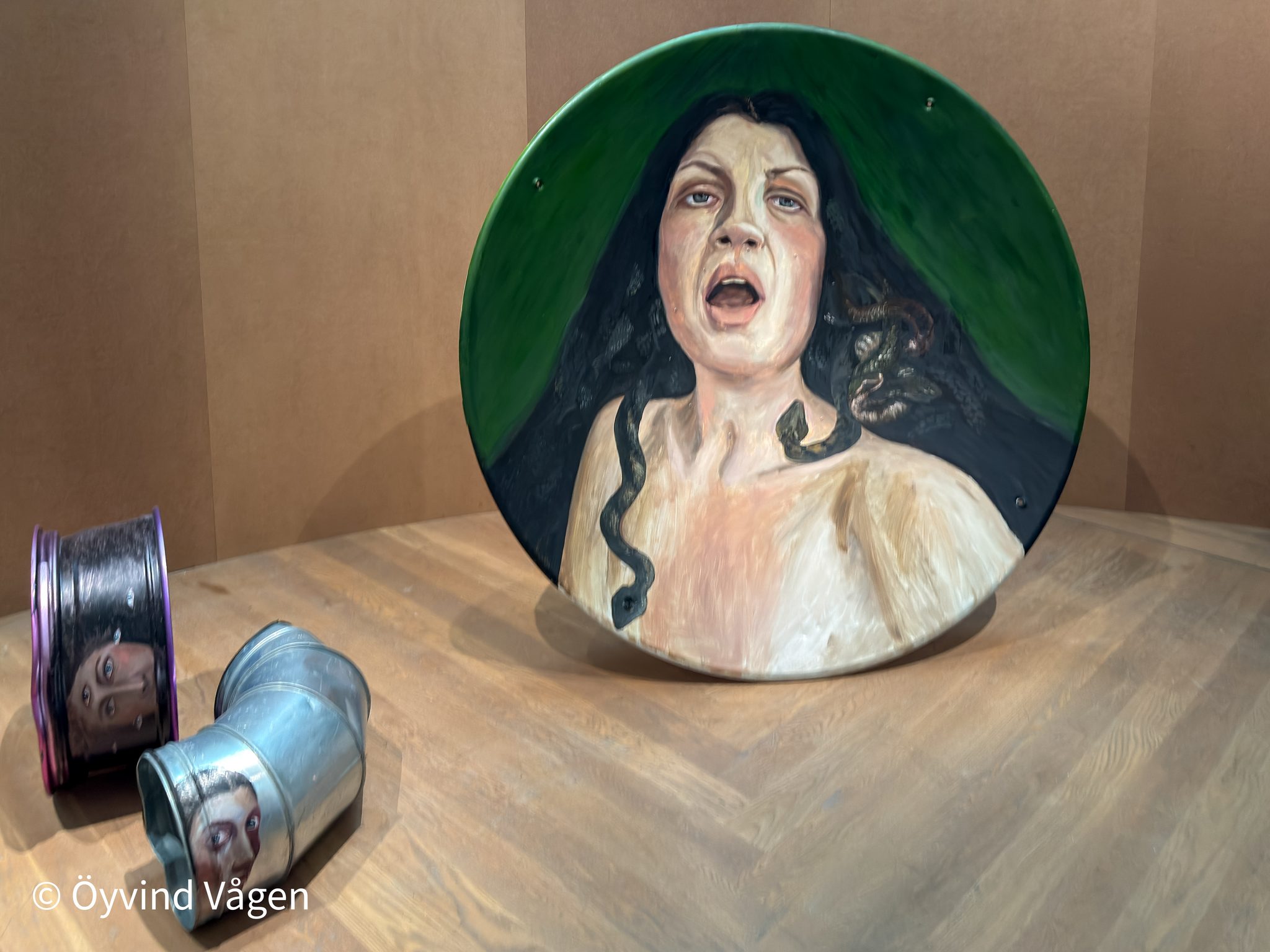
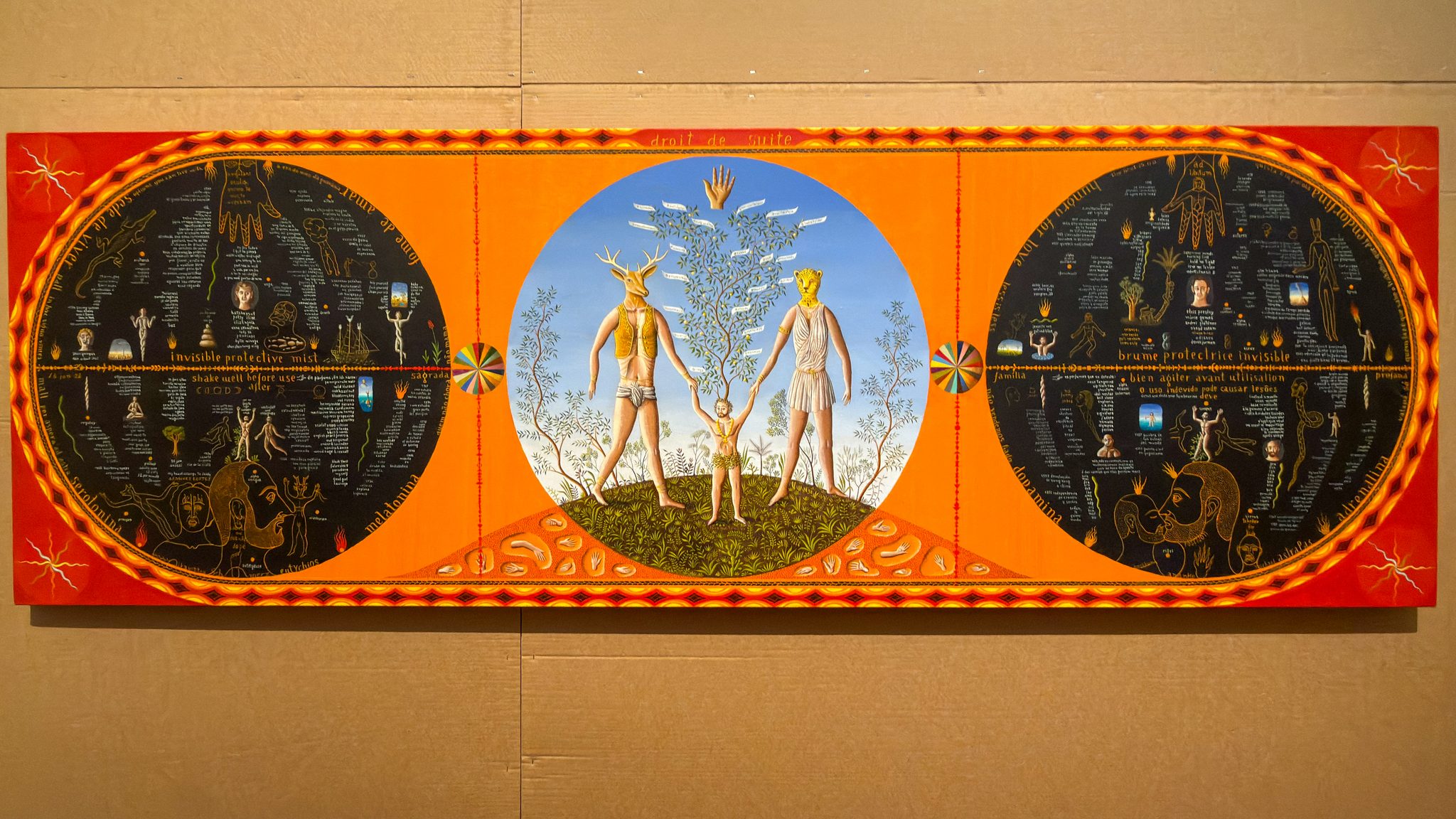
From here emerges a constellation of figures that do not function as mere quotations but as tools for symbolic construction. In Mikołaj Sobczak’s Parole, Parole, Parole, Kleio, Ludwig II, the Uranians and tarot cards compose a queer, fabulatory genealogy. In Naudline Pierre’s Chiasma, the artist’s winged avatar opens up a spiritual and visionary cosmology of self-representation. In Alex Červený’s Droit de suite, the cosmogram becomes a votive panel and an assertion of the right to exist. In Selma Selman’s Gorgons (Do Not Look Into Our Eyes), Medusa is not a mythological quotation, but a figure reactivated through gaze and vulnerability.
Nicole Eisenman provides the exhibition’s point of departure, positioned almost as a genealogical threshold within the itinerary. Since the 1990s, her painting has helped reopen figuration as a critical space: not a nostalgic return to the canvas, but a fragile field in which art history, the body, satire, politics, queer culture and everyday life condense into allegorical images. Her diptych Progress: Real and Imagined (2006), placed at the entrance to the exhibition itinerary, serves almost as a conceptual matrix.
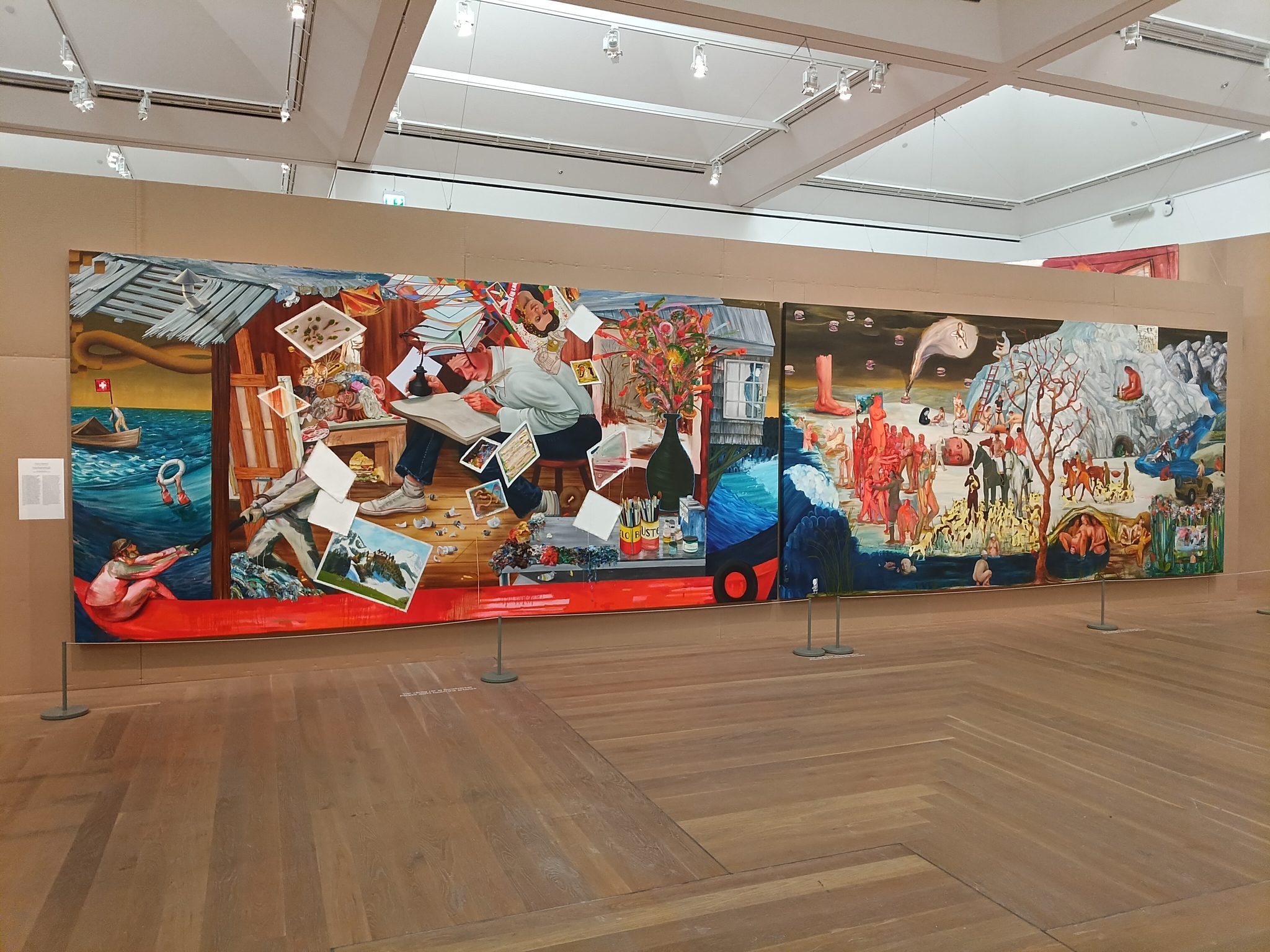
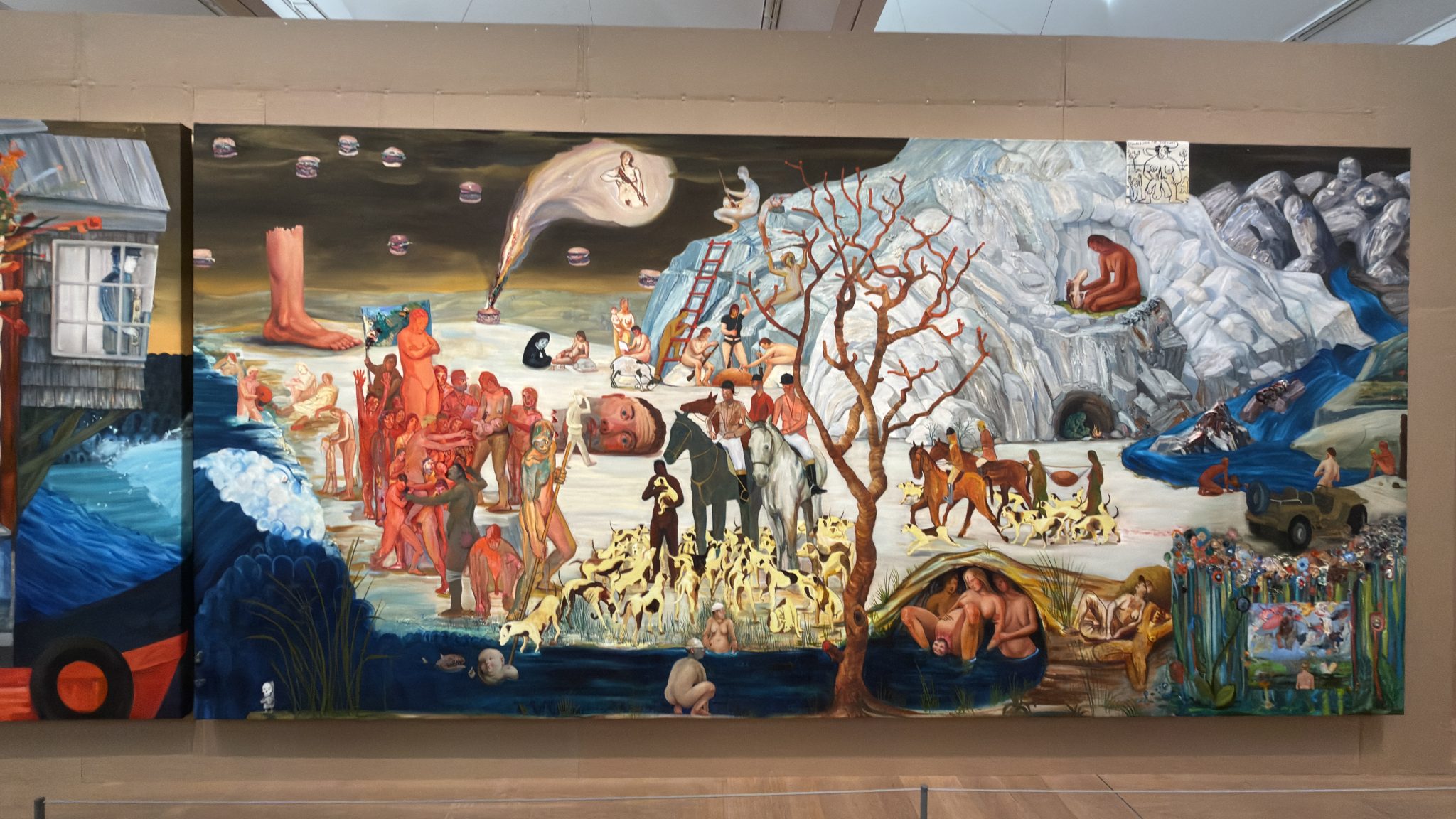
From this threshold, the exhibition opens onto a plurality of genealogies and artistic sensibilities, traversed in different ways by symbols, mythologies and forms of otherness: queer, diasporic, migrant, postcolonial and spiritual experiences, or simply positions that exceed any univocal or dominant reading.
Body, gaze and vulnerability
In Światło małego miasteczka / Small Town Light (2025), Agata Słowak reinforces the theme of the exposed and controlled body. Light does not merely illuminate: it watches, eavesdrops and disciplines. The small town of the title is not only a geographical place but also a social structure in which the collective gaze produces shame, exposure, and control.
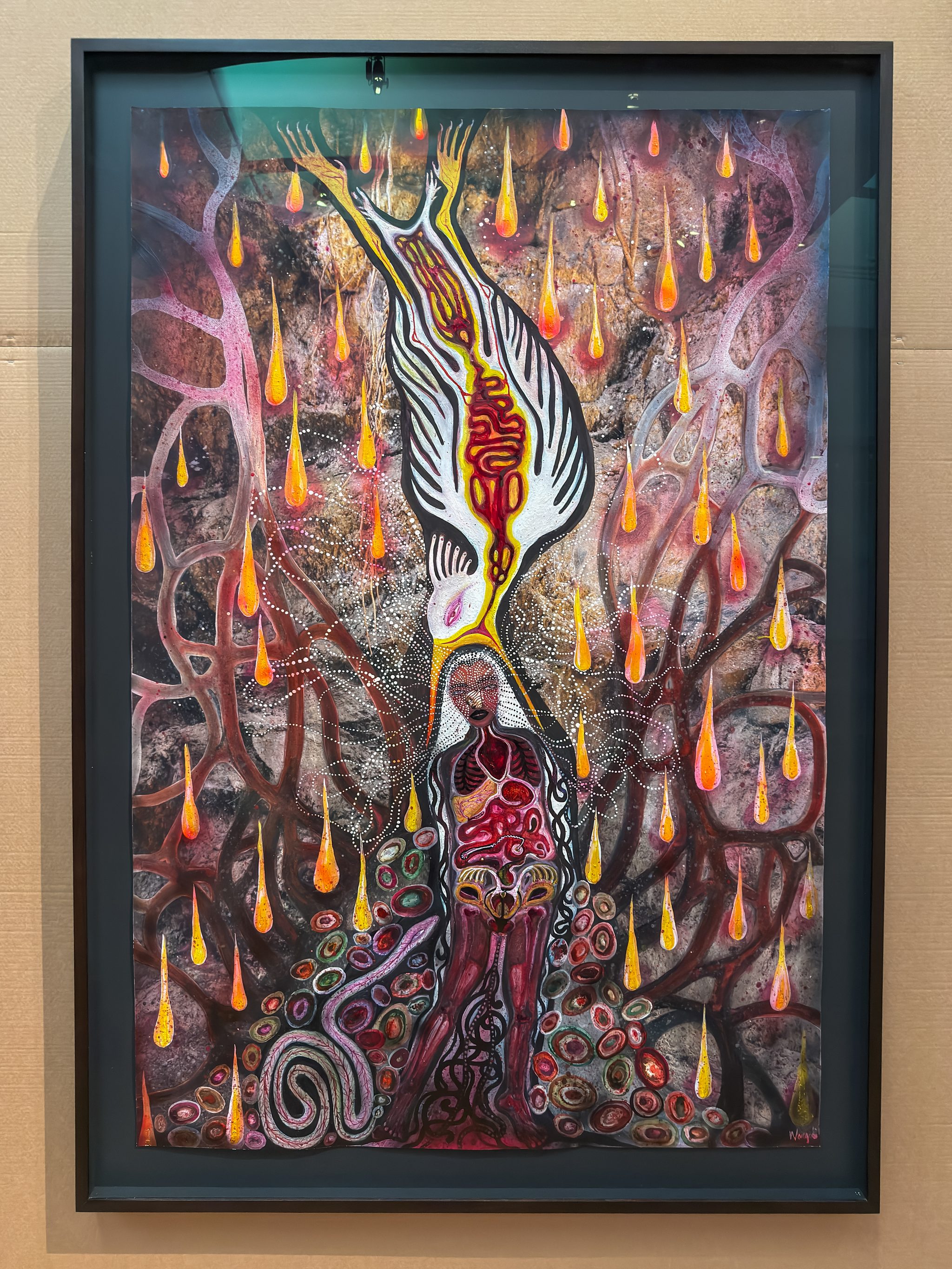
In Subterranea Falling Flames (2023), Wangechi Mutu works with the fragmented and hybrid body as a space of transformation, memory and resistance to imposed classifications. The figure never appears as a lost identity, but as an organism in metamorphosis, traversed by memory, matter, desire and history.
“Allegory becomes an unstable encounter rather than a pacified metaphor: something genuinely happens when gazes meet.”
Sanya Kantarovsky’s Scarecrow (2025) similarly reinforces the idea of painting not as a closed message but as a relationship among the surface, the body, and the viewer. The artist describes the work as something not exhausted by the object itself: it seems to exist “in the air” between the viewer and the surface of the painting.
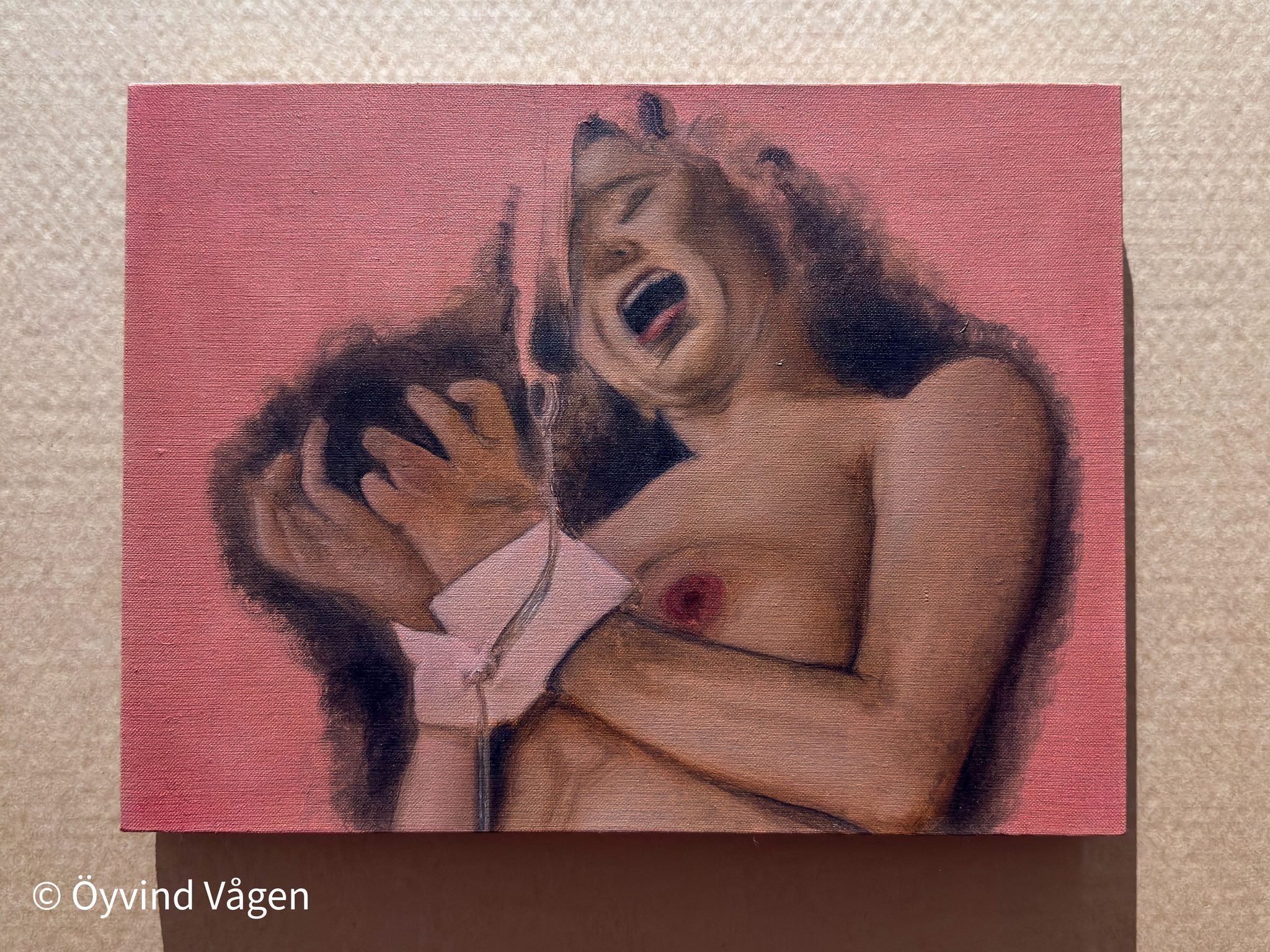
In Selma Selman’s work, too, the gaze is not merely symbolic, but active and dangerous. In Gorgons (Do Not Look Into Our Eyes) (2026), the mythic symbol — Medusa and her petrifying gaze — is not decorative but operative. Allegory becomes an unstable encounter rather than a pacified metaphor: something genuinely happens when gazes meet.
History, coloniality and war
The most explicitly political section of the exhibition opens onto war, coloniality, racialisation, economics, disinformation and survival.
“The canvas becomes both a field of memory and a battlefield, a place where war, the body, fear and survival accumulate.”
In Account of an Illiterate Man (2020), Michael Armitage works on a support that already carries meaning: Lubugo bark cloth. The material introduces oral, ecological and non-Western forms of knowledge, challenging the assumption that knowledge must always pass through writing or dominant systems of archiving.
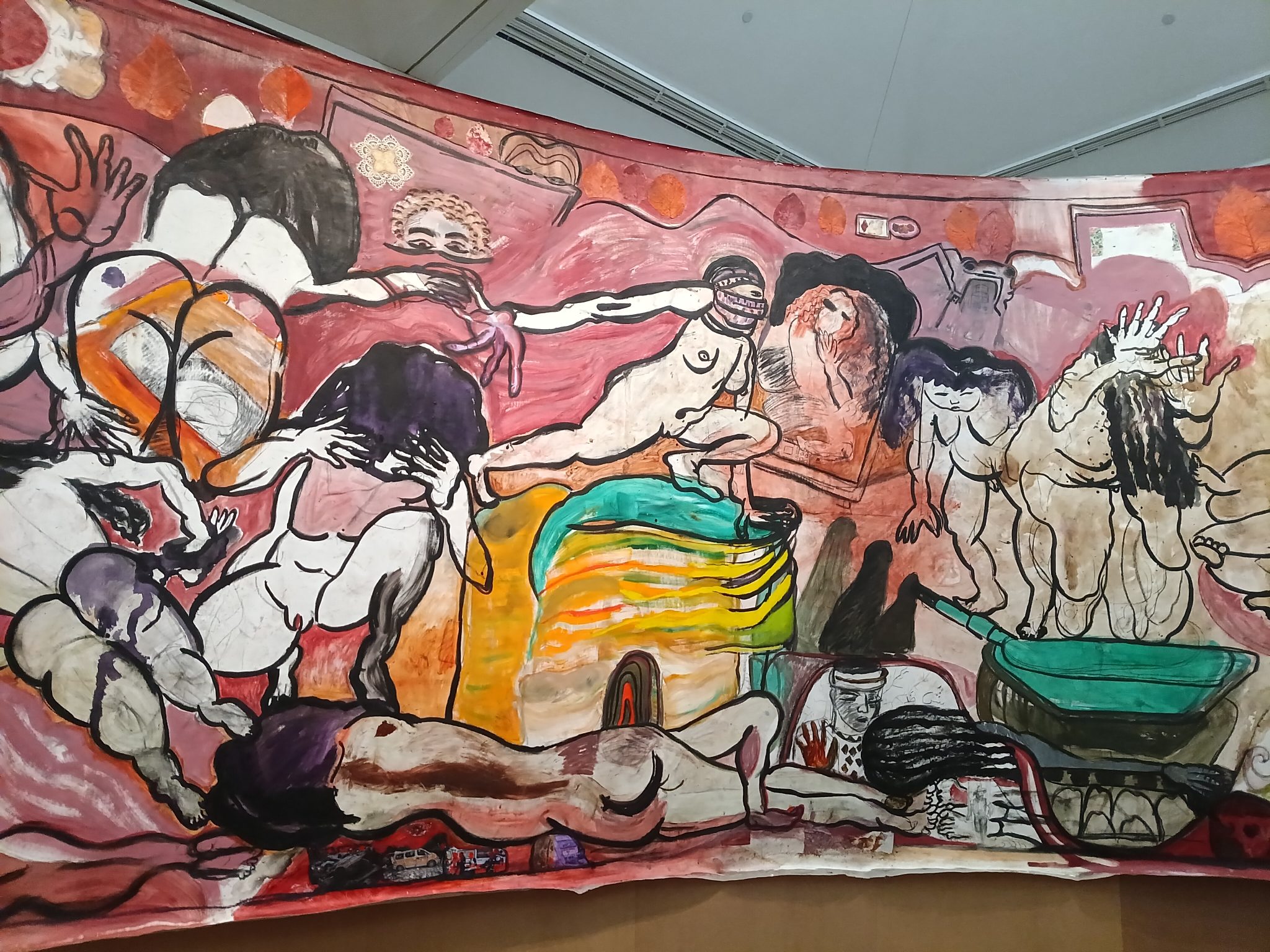
With ُﺳدﻓﺔ – Sudfa (Chance) (2026), Mounira Al Solh brings the discussion of allegory out of the realm of abstraction. The canvas becomes both a field of memory and a battlefield, a place where war, the body, fear and survival accumulate. The darkest hour of the night evoked by the title is not merely a poetic image: for Al Solh, who grew up in Beirut during the war, it was the moment when one had to prepare for the possibility of death.
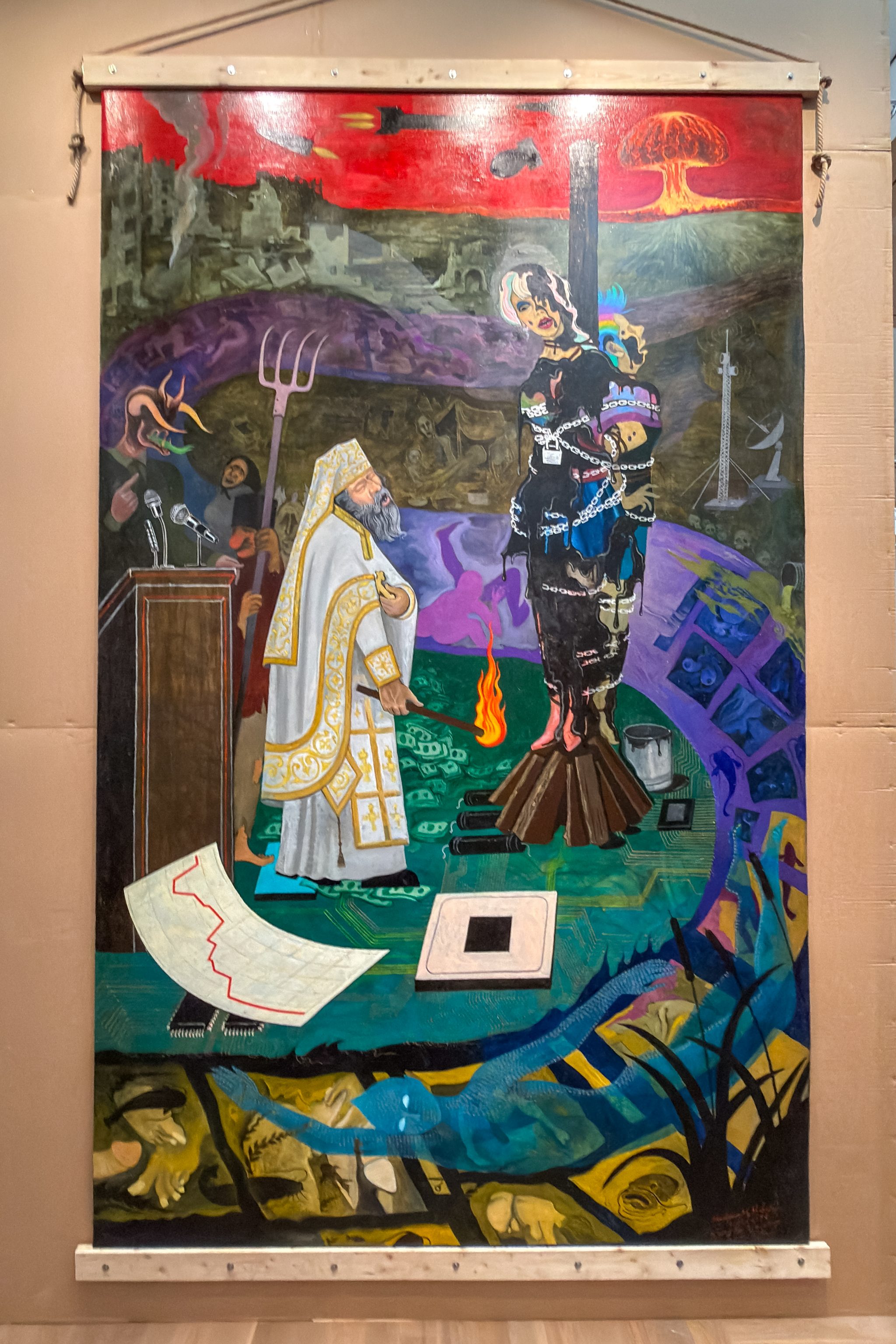
In Fixing the Economy (2026), a work rich in iconographic references, Hortensia Mi Kafchin addresses the economy as an almost divine and despotic entity: a system that holds lives hostage and shapes decisions, discrimination and inequality. The painting also stages the double standard through which LGBTQ+ communities, migrants and vulnerable groups are accused or blamed simply for existing, while violence and atrocities for which they bear no responsibility unfold in the background.
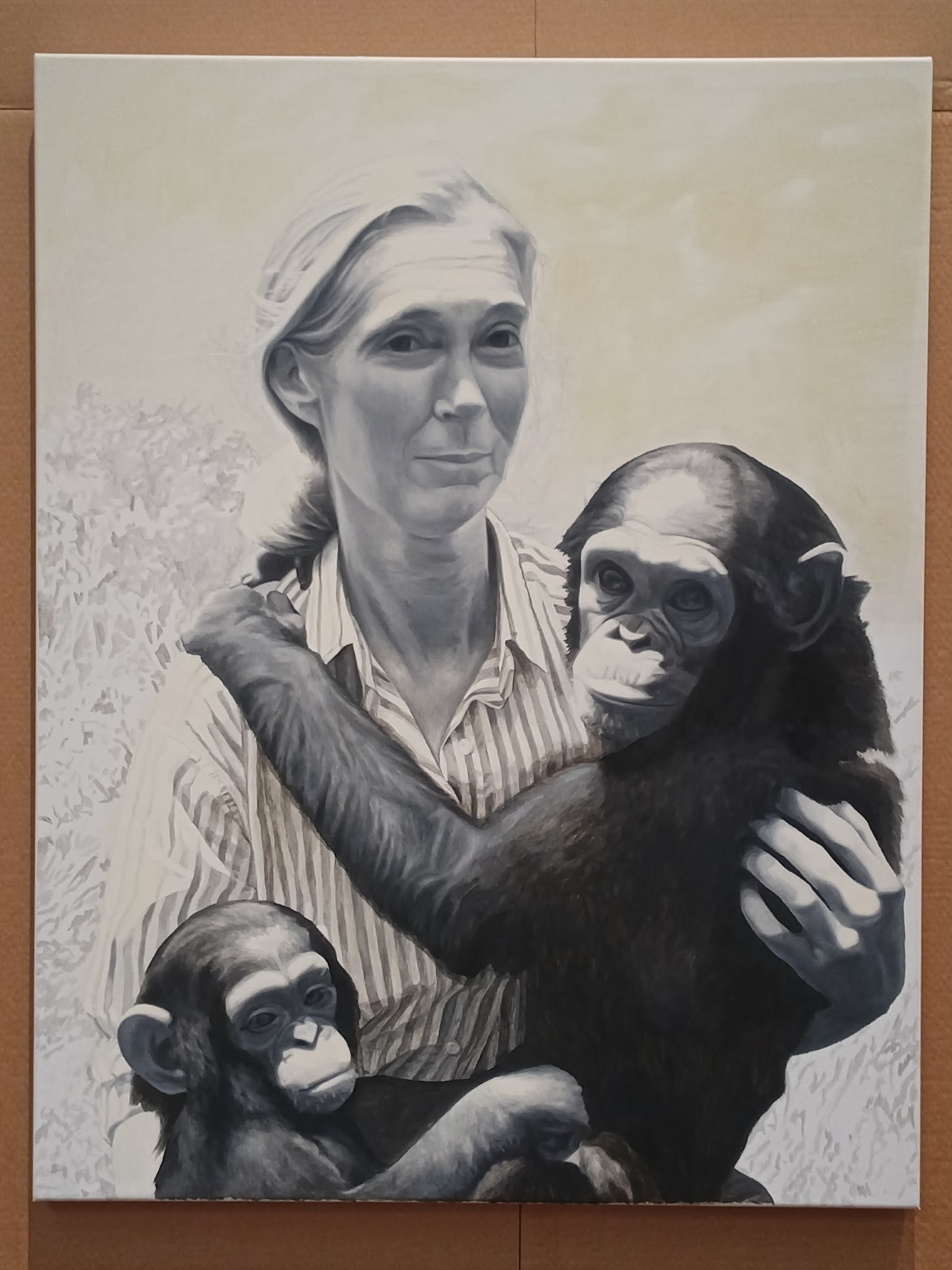
Hamishi Farah’s Untitled (2026) introduces one of the exhibition’s most theoretically complex passages. The painting depicts Jane Goodall with two chimpanzees, but recalls the iconography of the Virgin and Child with the infant Saint John the Baptist, a subject particularly widespread in Italian Renaissance painting. Drawing on Didi-Huberman and Hortense J. Spillers, Farah addresses the survival of images and iconographic violence. Apparently familiar images continue to carry deep structures of power, racialisation and symbolic predestination even when their context changes.
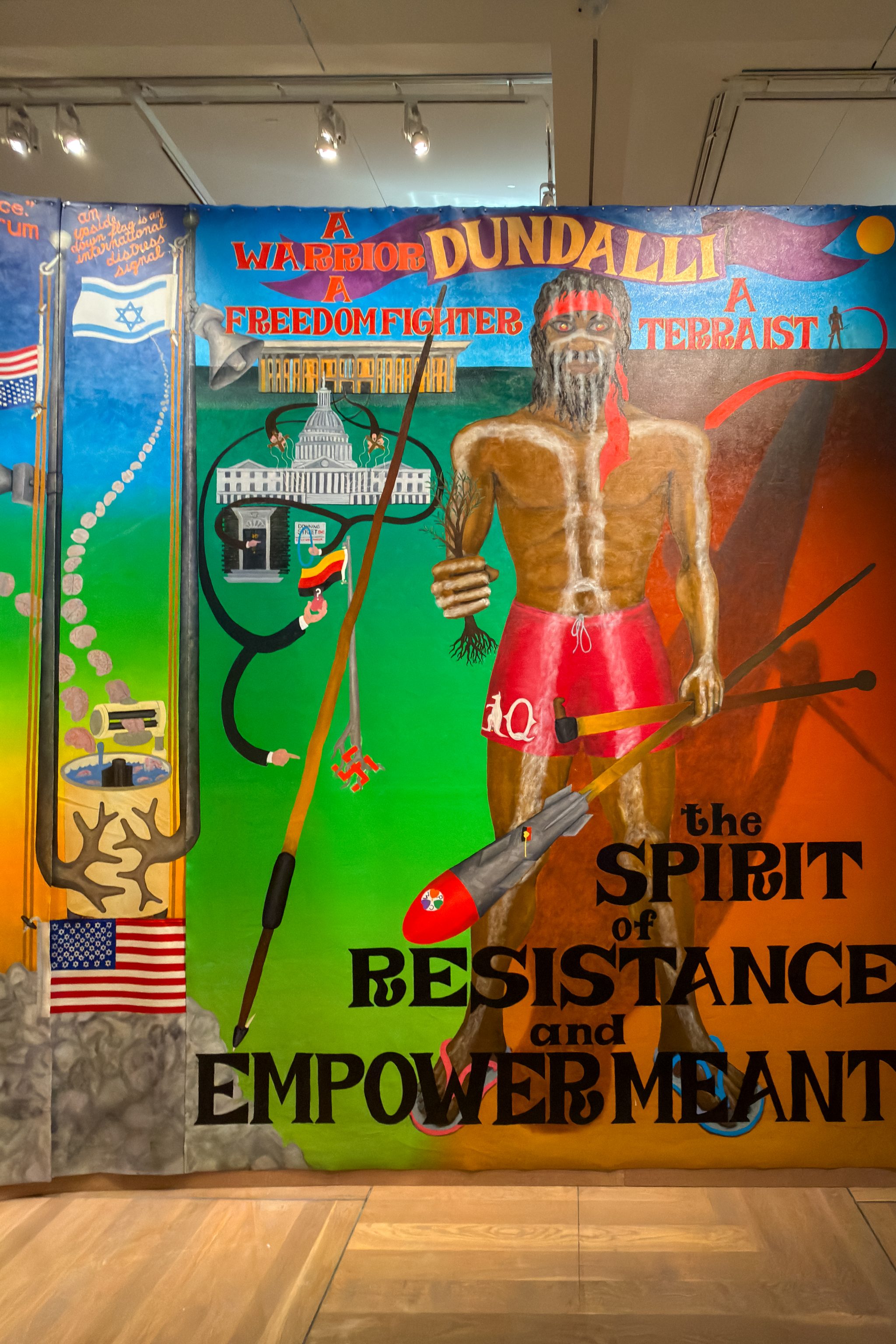
In Resistance’n’empowerment (2026), Gordon Hookey rewrites history painting from the perspective of Indigenous sovereignty and colonial violence. At the centre of the work is Dundalli, a historical figure of Aboriginal resistance. The olive branch, words, texts, and cartoons serve as points of access to the painting and as instruments for criticising misinformation, the business of power, and contemporary dehumanisation.
Portals, the subconscious and worlds
After the exhibition’s more explicitly political works, House of Nisaba turns towards painting as a perceptual experience, an opening towards the subconscious and a means of constructing worlds. This shift does not leave politics behind; rather, it extends the exhibition’s interest in allegory into the realms of dream, cosmology, and inner life.
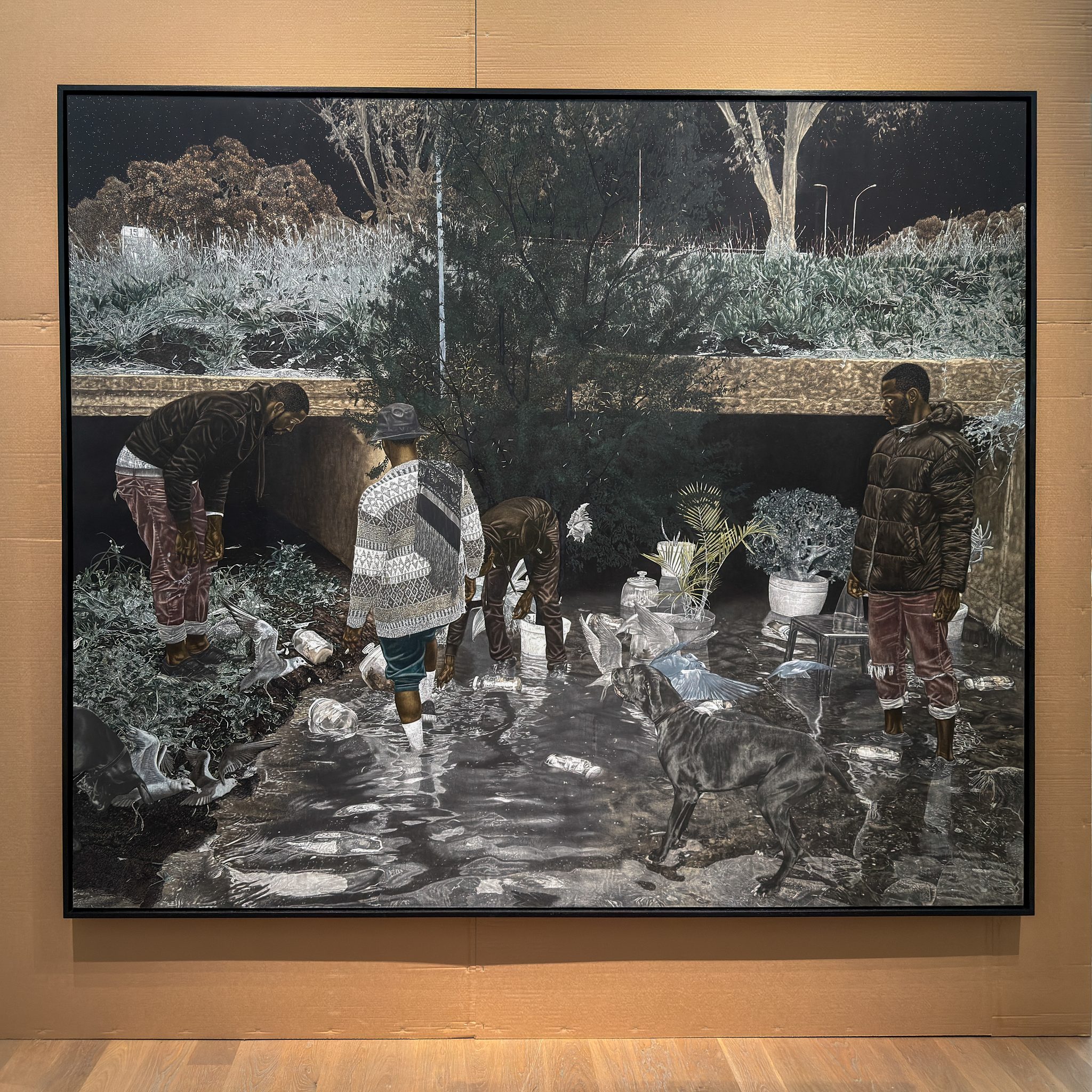
In Emthonjeni (A Spring) (2026), Cinga Samson speaks of painting as a portal into the subconscious. Although composed of recognisable elements — human figures, dogs, birds, vegetation and water — the scene seems to belong to a slightly displaced reality, familiar yet not entirely decipherable. The painting does not merely represent a scene: it introduces us to a broader, almost cosmic experience.
In Droit de suite (2026), Alex Červený constructs a genuine cosmogram. The work becomes a votive panel, a secular altar, an archive of images and an assertion of the right to exist. Within his universe, Byzantine painting, popular culture, personal memory, stars, algorithms, icons and fragments of art history coexist.
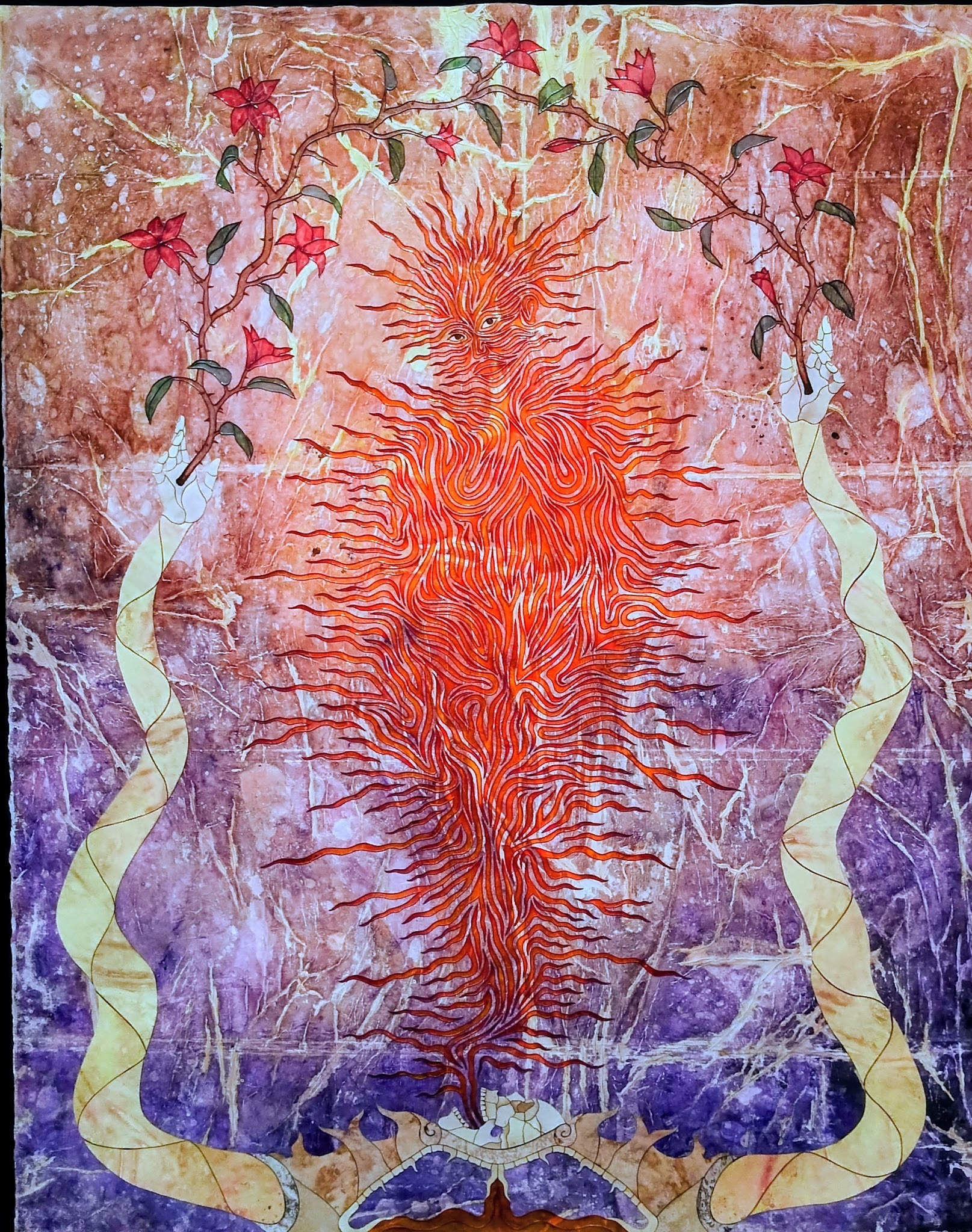
In Howl, Inverted (2026), Melanie Kitti works from a form of personal archaeology. Difficult memories, the artist suggests, rarely appear as complete stories; they arrive instead as fragments, bodily impressions and forms emerging from the subconscious. Painting thus becomes a way of excavating memory, matter and dream.
In Insurgent Intimacies (2025), Felipe Baeza constructs vegetal, bodily and spiritual figures that give form to a queer and migrant temporality removed from linear progression.
Here, too, the body is not a closed identity but a passage: something that germinates, transforms, resists and takes shape through unstable relationships. This final movement brings together many of the exhibition’s recurring terms — body, memory, myth, politics and metamorphosis — before the essay returns to the house as its concluding image.
Conclusion
The exhibition is sustained by a powerful allegorical and conceptual framework, one that at times decisively guides the interpretation of the works and leaves somewhat less space for the viewer’s unguided encounter. The strength of the exhibition, and of Folkerts’s proposal, lies precisely in its plurality. Symbols, bodies, gestures, myths, wars, personal archives, and collective memories are not ordered into a single discourse but are allowed to coexist within a provisional house.
“Here, painting is not merely a medium to be looked at and, above all, it does not simply ‘illustrate’ ideas: it acts.”
Here, painting is not merely a medium to be looked at and, above all, it does not simply “illustrate” ideas: it acts. It supports, watches, remembers, wounds, protects, transmits, opens portals and constructs genealogies. Through the different practices and philosophies of the artists, it becomes an allegorical, narrative, political and almost performative form in its own right: a way of thinking about the present when linear narratives can no longer contain it.
I leave this house grateful to have been its guest for a while. Not a house in which to live, but a temporary structure in which images remain together long enough to allow us to recognise something of the present: its violence, its fragmentation, and also its persistent need to invent new forms of narrative — new stories, as the plural in the title suggests.
Chiara Gelmini is an Italian art writer, curator and interdisciplinary artist. With a background in visual and performing arts and aesthetics, she works across contemporary art, music, performance and cultural education. Her work is shaped by travel, cultural crossings and the porous thresholds between places, disciplines and artistic languages. Her writing explores the relationships between artworks, exhibition contexts and audiences, and art as a space for encounter. Read more articles by Chiara Gelmini here. Photo: Serena Bobbo
SAMTLIGA ARTIKLAR I CRITICAL POINT #2 2026: Sara Shamloo Ekblad & Öyvind Vågen Critical Point: Ledare #13 – The tidskrift must go on I Sara Shamloo Ekblad & Öyvind Vågen Andreas Engström – en outtröttlig kraft i konstmusikens och kulturtidskrifternas värld I Petra Werner Staffan Westerberg och barnets magiska allvar I Mira Horovitz Barns rätt till kultur och det substantiella medborgarskapet i en orolig samtid I Öyvind Vågen It’s Written on the Wall I – Street Art the Riga Edition I Chiara Gelmini Welcome to Art Basel 2026? Inside and Outside the Fair I Sofia Thoresdotter Tankar om terapi eller boken om det jag aldrig skrev i journalen I Sofia Thoresdotter Bokutdrag: Julgransplundringen och den döde chefen I Carolina Hindsjö Bokutdrag: Solboken I Sara Shamloo Ekblad ”Gå till änglarna när du har det svårt” – intervju med konstnären Carolina Hindsjö I Sonia Engström Jarema i Kraków – en mångfacetterad polsk konstnär på tvärs mot konventionerna och genrekraven I Chiara Gelmini House of Nisaba: New Stories of Painting I Freke Räihä Vem tjänar på all denna AI-stöld? I Petra Werner När Filmarkivet släcks – Petra Werner om en digital kulturskatt som försvinner I Petra Werner När Stanley Kubrick låter musiken öppna avgrunden – filmmusik, övermänniska och det kosmiskt okända I Petra Werner När musiken tänker hos Woody Allen – Manhattan, filmmusik, nutidsmänniska och kollektivt minne I Sam Carlquist Nyskrivet: De fyra hästarna I Mickaela Persson Nyskrivet: Sapfisk strof till Lady Kait I Mickaela Persson Sex frågor om poesi till Mickaela Persson I Emil Erdtman Nyskrivet: Allt försvinner utom det förflutna I Emil Erdtman Sex frågor om poesi till Emil Erdtman I Öyvind Vågen Nyskrivet: Den store rorsmannen och årtullarna I Öyvind Vågen Sex frågor om poesi till Öyvind Vågen I Simon Carlfjord Mellan Stenbordet och Kvaldalen I Simon Carlfjord Bubblor och skum – senmodernitetens symboliska koherens I Sonia Engström Historien som slagfält: Polen, Ukraina och UPA:s långa skugga




8 svar på ”House of Nisaba: New Stories of Painting ”