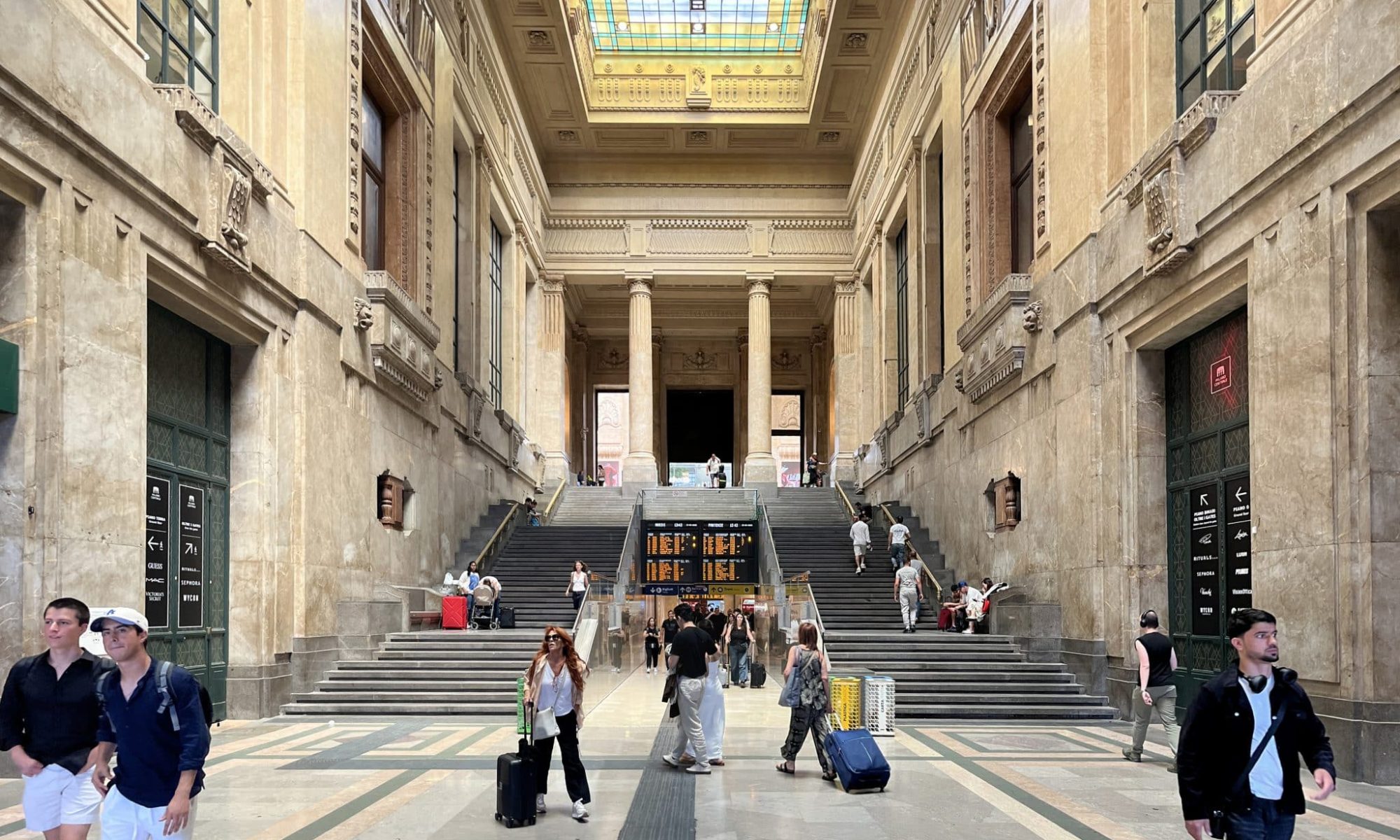
Young Italians are leaving a country everyone loves, and taking with them what they wanted to give it. Others take to the streets to demand a future.
By Chiara Gelmini

From the outside, Italy looks like a film with a beautiful soundtrack.
The weather, the food, the landscapes, the art, the architecture, the pleasure of sitting outside with friends over a glass of good, affordable wine. A country where life, supposedly, is warm and colourful.
Well, much of that image is true. Which makes the question even more uncomfortable: why would anyone think of leaving such a paradise?
We tend to assume that people leave to get more for themselves. Often they leave because they cannot find a place to give what they have.
I recently made that choice myself. At forty, after years working in the arts, education and cultural production, I arrived in Stockholm just as winter was setting in. I have no illusions about Sweden. Finding work in a new country, in another language, is hardly a shortcut to an easier life.
Yet for many young Italians, the uncertainty of leaving has begun to feel more reasonable than the certainty of staying.
And this autumn Italy has been giving people plenty of reasons to question their future there.
What’s Going On
This October, truckers’ blockades disrupted fuel and food supplies in parts of southern Italy, including deliveries to supermarkets and production of the celebrated mozzarella di bufala. The drivers were protesting soaring diesel prices. The image was almost absurd: a country famous for its food struggling to keep its supermarkets supplied. The protests eased after talks and the announcement of government support, but the pressures behind them remained.
Then came the violence in Milan. After the clashes of 17 and 18 October, the debate fixed on broken shop windows and the proper way to protest. It was striking how little of it was about what had brought so many young people into the streets. On 20 October, the government approved a decree-law, effective from 23 October, creating an offence of organised violence at public demonstrations and introducing a rebuttable presumption of criminal capacity for 14- to 17-year-olds. The problems behind the protests have been addressed with less haste.
On 30 October the protests went national. A general strike called by USB, a grassroots union outside Italy’s main confederations, brought students, workers, farmers, pensioners and housing activists into the streets of more than sixty cities, against the rising cost of living, rising rents and military spending. The numbers were disputed, as always: public-security authorities estimated 255,870 demonstrators, while USB claimed 1.5 million. The union also claimed that at least one million workers joined the strike, a separate figure from attendance at the demonstrations. Most marches were peaceful; in Rome and Turin, the evening ended with police charges and water cannons.

The Rome march ended with tents pitched on Via dei Fori Imperiali, in front of the Colosseum, where students, workers and housing activists remained through the weekend. Against one of Italy’s most famous monuments, they were asking for something rather less monumental: a place they could afford to live. “We have lost trust in institutions,” students told ANSA, Italy’s news agency.

Truckers, students and unions want different things, and the peaceful majority should not be confused with the violent few. What they share is the feeling that nobody is listening. The trade-union confederation CGIL has called a general strike for 20 November 2026.
Slave to the Wage
Italy’s economic troubles are familiar: high public debt, weak productivity, sluggish growth, an ageing population. But these explanations can make the consequences sound strangely abstract.
According to the OECD (Organisation for Economic Co-operation and Development), Italian real wages in the first quarter of 2026 were still 6.1% below their level in the first quarter of 2021. Employment has risen and unemployment has fallen, as the government regularly points out. Both are real improvements. But recovering jobs is not the same as recovering purchasing power.
The real questions are whether these jobs cover the cost of living, match people’s qualifications, allow them to grow and leave room to build something independently.
A decent wage is only part of the answer. Affordable housing, childcare, healthcare, reliable public services and social protection are equally important. Independence cannot be built on willpower alone.
In 2025, the estimated average age of leaving the parental home was 30.2 in Italy, compared with 26.3 across the EU. In Sweden, where the average is 23.1, I see a culture that encourages independence and supports it through student grants and loans. Southern Europeans are often mocked for being excessively attached to their families. Cultural habits certainly play a role. But how much support do young people actually receive in becoming independent? Perhaps the famous Italian mammoni (mama’s boys) deserve a little more economic analysis and a little less easy ridicule.
According to ISTAT, Italy’s national statistics institute, 5.4 million people living in Italy were in absolute poverty in 2025, with household consumption below ISTAT’s threshold for essential goods and services: roughly one resident in ten, in a country of just under 59 million. The landscape may be beautiful, but it doesn’t pay the rent.
“Independence cannot be built on willpower alone.”
Time to Say Goodbye
Between 2011 and 2024, some 630,000 Italians aged 18 to 34 moved abroad, according to a 2025 report by Italy’s National Council for Economics and Labour (CNEL). After accounting for the corresponding inflows, the net loss was 441,000 young people. Among those who left between 2022 and 2024, 42.1% were university graduates.
CNEL estimated the human capital associated with this net emigration at €159.5 billion in 2024 prices, based on investment in upbringing and education. This is not a direct loss of GDP, but an estimate of the investment embodied in people whose skills and work may now benefit other countries.
Emigration is not necessarily a problem. People leave out of curiosity, for love, education or ambition, or for the pleasure of discovering somewhere new. Freedom of movement is one of Europe’s great achievements. But how freely do people feel they are choosing?
In 2024, almost a quarter of graduates aged 20 to 34 living in Italy who had current or previous work experience considered themselves overqualified for their current or most recent job, according to ISTAT. A small survey in the same CNEL report, of former students of Italy’s merit colleges, found that 31% of its 148 respondents lived abroad. Better career prospects and higher pay were both leading motives for moving abroad. The survey concerns a small, highly selected group, but it is telling.
After years of studying, working, gaining experience and adapting to changing requirements, people reasonably expect their efforts to lead to meaningful work under fair conditions, if not to wealth or prestige. That such a basic hope has to be stated says something about the starting point.
What troubles me most is rarely said: many who leave, and many who stay, would like to give more to their country, not only receive more from it.
In the cultural sector, where I have spent much of my professional life, the problem is painfully familiar. Italy celebrates its museums, theatres, music, festivals and artistic heritage as defining features of its identity. Yet those who make that culture, unless they are Michelangelos or Morricones, often find that expertise is mistaken for enthusiasm, visibility for remuneration, and the privilege of working in culture (supposedly your favourite hobby) for a substitute for decent conditions.
You are expected to be creative, entrepreneurial, adaptable, constantly updating your skills, and … grateful for the opportunity. Making an actual living from your work can be another matter, and for many is not even a realistic prospect. In Italy, when I hand over an invoice as a singer and explain that it includes taxes and pension contributions, people often look puzzled. I have also been asked to lower my fee, with a confidence they would never show their mechanic. Here in Stockholm, so far, when I say I am an artist nobody looks at me with pity or asks what my real job is.
Italy has excellent institutions and people doing remarkable work within them. With more room to grow, they could do far more.
“What troubles me most is rarely said: many who leave, and many who stay, would like to give more to their country, not only receive more from it.”
The familiar expression brain drain captures only part of the loss. Alongside qualifications and professional expertise, Italy loses relationships, initiative, creativity and projects that might otherwise have taken shape at home.
The Kids Aren’t Alright
Some losses are easier to count than others. The flat never rented. The artistic project abandoned. The child never born.
That last one, at least, has a number. Like much of Europe, Italy is having fewer children: 355,772 births in 2025, with fertility down to 1.14 children per woman, a new historical low, and lower still in provisional figures for January–July 2026. Part of the fall is arithmetic: there are fewer potential parents. But insecure work, housing costs, inadequate childcare and unequal care responsibilities hardly make starting a family easier.
The government has repeatedly presented the falling birth rate as a national priority. Yet in ISTAT’s 2024 survey, half of women aged 18 to 49 believed that having a child would worsen their job prospects, rising to more than 65% among those aged 18 to 24. Most men expect no effect on their careers.
The fear is well founded. In 2025, mothers accounted for 68% of the resignations and mutually agreed contract terminations validated under Italy’s special procedure for parents. Among the reasons given by mothers, almost four in five concerned difficulties reconciling work and childcare, while fathers mostly cited a move to another employer. In 828 cases, mothers reported that their employer had refused to grant part-time hours, compared with just 14 fathers. A study in the 2024 annual report of INPS, the national social security institute, documents a lasting earnings penalty after a first child among mothers employed in the non-agricultural private sector, with no comparable decline among fathers. The gap between them persists. Only 58% of women aged 20 to 64 in Italy were in work in 2025, against an EU average of 71.3%. Without adequate political and economic support, becoming a mother can mean accepting a smaller working life.
“Without adequate political and economic support, becoming a mother can mean accepting a smaller working life.”
There is another contradiction. Italy worries about falling birth rates, yet one baby in eight born there in 2025 had foreign citizenship, and children born or raised in Italy to foreign parents still face considerable obstacles to becoming Italian. Birth or schooling in Italy does not, in itself, generally confer Italian citizenship. These children may speak Italian, attend Italian schools and know no other home, yet remain legally foreign.
The country struggles to retain some of the people it has educated, while failing to fully recognise others who have grown up within it.
Another Day in Paradise
In September 2026, Meloni’s right-wing coalition government became the longest-serving in the history of the Italian Republic after 1,413 days in office, one more than Berlusconi’s second government. Meloni said that stability is the condition that allows a nation to plan, decide and keep its commitments.
Fair enough. Italy has changed governments often, and reforms take time. But if stability is the condition for planning, the question is what has been planned, and for whom. Many of Italy’s difficulties predate this government by decades; wage stagnation, regional inequality and insecure work cannot be pinned on one administration. Yet longevity also means more time to show which priorities are being pursued, and with what results.
Every year brings a report with the same headline: wages still below where they were, young people leaving home at thirty, graduates leaving the country. The details change, the picture does not, and neither does the feeling it leaves: the problems are well known, endlessly discussed, never resolved. What is missing is a sense of direction: a credible plan for the years ahead, backed by sustained investment rather than temporary fixes and another round of slogans.
The OECD’s latest trust survey (carried out in 2025) found that 36% of respondents reported high or moderately high trust in Italy’s national government, unchanged since 2023 and a little below the 40% average across participating OECD countries. Sweden was at 42%. Only 22% of Italians feel they have a say in what the government does, and just 34% are confident that it balances the interests of different generations.
Italy is not alone in distrusting politics. Yet when so many people feel unheard, the way younger generations are treated in public debate matters even more.
“What disappears is not necessarily ambition, but the belief that there is a place for it.”
No Future?
Not all institutions are indifferent. Italy’s head of state, President Sergio Mattarella, who stands above party politics, said in May that adults too often fail to listen to young people’s aspirations or recognise their talents. On 21 October, at the Quirinale, the presidential palace, he warned against treating young people with indifference or, worse, belittling them, and said that many who have left would gladly return if offered a path in which they could fulfil their potential.
That same week, on Porta a Porta, a long-running talk show on RAI, Italy’s public broadcaster, veteran presenter Bruno Vespa interrupted Sabrina Brizzola, the 24-year-old leader of the university students’ union, UDU, as she discussed access to education. Whatever the merits of the figures on school dropout rates, he told her that young people should study and come prepared before speaking.
Vespa spoke to “you young people”, addressing students as a category rather than Brizzola as an individual. As the philosopher of language Irene Lo Faro noted in an Instagram post, the problem went beyond the accuracy of the figures: the exchange shifted from verifiable claims to identities and ideological camps. Brizzola later called it paternalistic and sexist. A week later Vespa said he was sorry for his tone but stood by the substance, saying his disappointment was that a young representative had not done her homework.
Disagreeing is legitimate. Talking down to someone is not. Rather than discussing students’ concerns, the exchange became a public reprimand, in striking contrast with Mattarella’s words.
Of the 271 people taken to police headquarters following the disturbances in Milan on 18 October, 220 were minors, according to police figures reported by the Italian press. Reports described mobilisation through social media, while participants’ motives remained disputed. Violence cannot be excused. Nor can it be left to the police alone. Young people don’t need to be politically sophisticated for their behaviour to deserve serious attention. Understanding what moves them, even when their actions are confused or destructive, is also a responsibility of the adults and institutions around them.
The decree focuses on criminal sanctions and public security. But punishment alone cannot explain or resolve the social tensions behind these events, any more than temporary financial aid can solve the structural problems exposed by the truckers’ blockades.
There is a point at which repeated disappointment begins to feel like betrayal. People spend years studying, working, developing skills and trying to contribute. They expect a fair chance to put those efforts to good use. When that chance repeatedly fails to materialise, something changes.
Some leave. Some take to the streets. Others stay, change professions, abandon projects or lower their expectations.
What disappears is not necessarily ambition, but the belief that there is a place for it.
And when people lose that belief, imagining a future becomes harder: investing in a career, starting a family, creating something new, even participating in public life.
Italy has no shortage of people with ideas, skills and the will to contribute. The question is how much longer it can afford to make so little room for them.
Chiara Gelmini is an Italian art writer, curator and interdisciplinary artist. With a background in visual and performing arts and aesthetics, she works across contemporary art, music, performance and cultural education. Her work is shaped by travel, cultural crossings and the porous thresholds between places, disciplines and artistic languages. Her writing explores the relationships between artworks, exhibition contexts and audiences, and art as a space for encounter. Read more articles by Chiara Gelmini.